


Page 112 - Euclid's Elements of Geometry
P. 112
ST	EW      dþ.                                                              ELEMENTS BOOK 4


                                    gþ                          ABC].


                                                                   Thus, a triangle, equiangular with the given triangle,
                                                                has been inscribed in the given circle. (Which is) the very
                                                                thing it was required to do.

            †  See the footnote to Prop. 3.34.

                                                                                  Proposition 3
                                      .
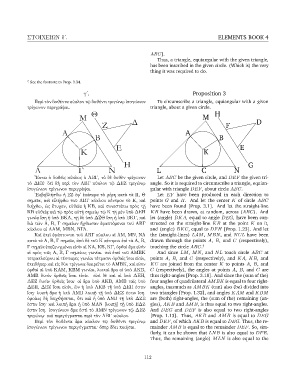
               Περὶ τὸν δοθέντα κύκλον τῷ δοθέντι τριγώνῳ ἰσογώνιον  To circumscribe a triangle, equiangular with a given
            τρίγωνον περιγράψαι.                                triangle, about a given circle.
                                       Θ                                                   H
                                  Μ                                                   M
                                            Ζ           ∆                                      F            D
                           Α                                                   A
                                         Β                                                   B

                                                  Ε                                                  E
                                   Κ                                                  K

                                                     Η                                                   G
                Λ                 Γ           Ν                    L                 C             N
               ῎Εστω ὁ δοθεὶς κύκλος ὁ ΑΒΓ, τὸ δὲ δοθὲν τρίγωνον   Let ABC be the given circle, and DEF the given tri-
            τὸ ΔΕΖ· δεῖ δὴ περὶ τὸν ΑΒΓ κύκλον τῷ ΔΕΖ τριγώνῳ   angle. So it is required to circumscribe a triangle, equian-
            ἰσογώνιον τρίγωνον περιγράψαι.                      gular with triangle DEF, about circle ABC.
               ᾿Εκβεβλήσθω ἡ ΕΖ ἐφ᾿ ἑκάτερα τὰ μέρη κατὰ τὰ Η, Θ   Let EF have been produced in each direction to
            σημεῖα, καὶ εἰλήφθω τοῦ ΑΒΓ κύκλου κέντρον τὸ Κ, καὶ points G and H. And let the center K of circle ABC
            διήχθω, ὡς ἔτυχεν, εὐθεῖα ἡ ΚΒ, καὶ συνεστάτω πρὸς τῇ  have been found [Prop. 3.1]. And let the straight-line
            ΚΒ εὐθείᾳ καὶ τῷ πρὸς αὐτῇ σημείῳ τῷ Κ τῇ μὲν ὑπὸ ΔΕΗ  KB have been drawn, at random, across (ABC). And
            γωνίᾳ ἴση ἡ ὑπὸ ΒΚΑ, τῇ δὲ ὑπὸ ΔΖΘ ἴση ἡ ὑπὸ ΒΚΓ, καὶ let (angle) BKA, equal to angle DEG, have been con-
            διὰ τῶν Α, Β, Γ σημείων ἤχθωσαν ἐφαπτόμεναι τοῦ ΑΒΓ  structed on the straight-line KB at the point K on it,
            κύκλου αἱ ΛΑΜ, ΜΒΝ, ΝΓΛ.                            and (angle) BKC, equal to DFH [Prop. 1.23]. And let
               Καὶ ἐπεὶ ἐφάπτονται τοῦ ΑΒΓ κύκλου αἱ ΛΜ, ΜΝ, ΝΛ  the (straight-lines) LAM, MBN, and NCL have been
            κατὰ τὰ Α, Β, Γ σημεῖα, ἀπὸ δὲ τοῦ Κ κέντρου ἐπὶ τὰ Α, Β, drawn through the points A, B, and C (respectively),
            Γ σημεῖα ἐπεζευγμέναι εἰσὶν αἱ ΚΑ, ΚΒ, ΚΓ, ὀρθαὶ ἄρα εἰσὶν touching the circle ABC. †
            αἱ πρὸς τοῖς Α, Β, Γ σημείοις γωνίαι. καὶ ἐπεὶ τοῦ ΑΜΒΚ  And since LM, MN, and NL touch circle ABC at
            τετραπλεύρου αἱ τέσσαρες γωνίαι τέτρασιν ὀρθαῖς ἴσαι εἰσίν, points A, B, and C (respectively), and KA, KB, and
            ἐπειδήπερ καὶ εἰς δύο τρίγωνα διαιρεῖται τὸ ΑΜΒΚ, καί εἰσιν KC are joined from the center K to points A, B, and
            ὀρθαὶ αἱ ὑπὸ ΚΑΜ, ΚΒΜ γωνίαι, λοιπαὶ ἄρα αἱ ὑπὸ ΑΚΒ, C (respectively), the angles at points A, B, and C are
            ΑΜΒ δυσὶν ὀρθαῖς ἴσαι εἰσίν. εἰσὶ δὲ καὶ αἱ ὑπὸ ΔΕΗ,  thus right-angles [Prop. 3.18]. And since the (sum of the)
            ΔΕΖ δυσὶν ὀρθαῖς ἴσαι· αἱ ἄρα ὑπὸ ΑΚΒ, ΑΜΒ ταῖς ὑπὸ four angles of quadrilateral AMBK is equal to four right-
            ΔΕΗ, ΔΕΖ ἴσαι εἰσίν, ὧν ἡ ὑπὸ ΑΚΒ τῇ ὑπὸ ΔΕΗ ἐστιν angles, inasmuch as AMBK (can) also (be) divided into
            ἴση· λοιπὴ ἄρα ἡ ὑπὸ ΑΜΒ λοιπῇ τῇ ὑπὸ ΔΕΖ ἐστιν ἴση. two triangles [Prop. 1.32], and angles KAM and KBM
            ὁμοίως δὴ δειχθήσεται, ὅτι καὶ ἡ ὑπὸ ΛΝΒ τῇ ὑπὸ ΔΖΕ are (both) right-angles, the (sum of the) remaining (an-
            ἐστιν ἴση· καὶ λοιπὴ ἄρα ἡ ὑπὸ ΜΛΝ [λοιπῇ] τῇ ὑπὸ ΕΔΖ  gles), AKB and AMB, is thus equal to two right-angles.
            ἐστιν ἴση. ἰσογώνιον ἄρα ἐστὶ τὸ ΛΜΝ τρίγωνον τῷ ΔΕΖ  And DEG and DEF is also equal to two right-angles
            τριγώνῳ· καὶ περιγέγραπται περὶ τὸν ΑΒΓ κύκλον.     [Prop. 1.13]. Thus, AKB and AMB is equal to DEG
               Περὶ τὸν δοθέντα ἄρα κύκλον τῷ δοθέντι τριγώνῳ   and DEF, of which AKB is equal to DEG. Thus, the re-
            ἰσογώνιον τρίγωνον περιγέγραπται· ὅπερ ἔδει ποιῆσαι.  mainder AMB is equal to the remainder DEF. So, sim-
                                                                ilarly, it can be shown that LNB is also equal to DFE.
                                                                Thus, the remaining (angle) MLN is also equal to the


                                                             112

