


Page 117 - Euclid's Elements of Geometry
P. 117
ST	EW      dþ.      hþ


                                                                                            ELEMENTS BOOK 4


                                      .
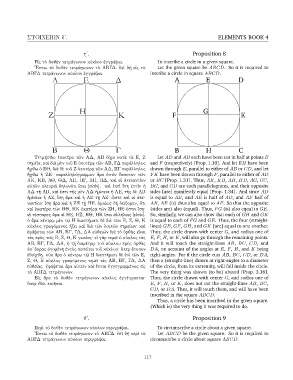
                                                                                  Proposition 8
               Εἰς τὸ δοθὲν τετράγωνον κύκλον ἐγγράψαι.            To inscribe a circle in a given square.
               ῎Εστω τὸ δοθὲν τετράγωνον τὸ ΑΒΓΔ. δεῖ δὴ εἰς τὸ    Let the given square be ABCD. So it is required to
            ΑΒΓΔ τετράγωνον κύκλον ἐγγράψαι.                    inscribe a circle in square ABCD.
                       Α            Ε            ∆                        A            E             D


                                  Η                                                   G
                     Ζ                            Κ                      F                            K


                       Β            Θ            Γ                        B            H             C
               Τετμήσθω ἑκατέρα τῶν ΑΔ, ΑΒ δίχα κατὰ τὰ Ε, Ζ       Let AD and AB each have been cut in half at points E
            σημεῖα, καὶ διὰ μὲν τοῦ Ε ὁποτέρᾳ τῶν ΑΒ, ΓΔ παράλληλος and F (respectively) [Prop. 1.10]. And let EH have been
            ἤχθω ὁ ΕΘ, διὰ δὲ τοῦ Ζ ὁποτέρᾳ τῶν ΑΔ, ΒΓ παράλληλος drawn through E, parallel to either of AB or CD, and let
            ἤχθω ἡ ΖΚ· παραλληλόγραμμον ἄρα ἐστὶν ἕκαστον τῶν   FK have been drawn through F, parallel to either of AD
            ΑΚ, ΚΒ, ΑΘ, ΘΔ, ΑΗ, ΗΓ, ΒΗ, ΗΔ, καὶ αἱ ἀπεναντίον or BC [Prop. 1.31]. Thus, AK, KB, AH, HD, AG, GC,
            αὐτῶν πλευραὶ δηλονότι ἴσαι [εἰσίν]. καὶ ἐπεὶ ἴση ἐστὶν ἡ  BG, and GD are each parallelograms, and their opposite
            ΑΔ τῇ ΑΒ, καί ἐστι τῆς μὲν ΑΔ ἡμίσεια ἡ ΑΕ, τῆς δὲ ΑΒ  sides [are] manifestly equal [Prop. 1.34]. And since AD
            ἡμίσεια ἡ ΑΖ, ἴση ἄρα καὶ ἡ ΑΕ τῇ ΑΖ· ὥστε καὶ αἱ ἀπε- is equal to AB, and AE is half of AD, and AF half of
            ναντίον· ἴση ἄρα καὶ ἡ ΖΗ τῇ ΗΕ. ὁμοίως δὴ δείξομεν, ὅτι  AB, AE (is) thus also equal to AF. So that the opposite
            καὶ ἑκατέρα τῶν ΗΘ, ΗΚ ἑκατέρᾳ τῶν ΖΗ, ΗΕ ἐστιν ἴση· (sides are) also (equal). Thus, FG (is) also equal to GE.
            αἱ τέσσαρες ἄρα αἱ ΗΕ, ΗΖ, ΗΘ, ΗΚ ἴσαι ἀλλήλαις [εἰσίν]. So, similarly, we can also show that each of GH and GK
            ὁ ἄρα κέντρῳ μὲν τῷ Η διαστήματι δὲ ἑνὶ τῶν Ε, Ζ, Θ, Κ  is equal to each of FG and GE. Thus, the four (straight-
            κύκλος γραφόμενος ἥξει καὶ διὰ τῶν λοιπῶν σημείων· καὶ lines) GE, GF, GH, and GK [are] equal to one another.
            ἐφάψεται τῶν ΑΒ, ΒΓ, ΓΔ, ΔΑ εὐθειῶν διὰ τὸ ὀρθὰς εἶναι Thus, the circle drawn with center G, and radius one of
            τὰς πρὸς τοῖς Ε, Ζ, Θ, Κ γωνίας· εἰ γὰρ τεμεῖ ὁ κύκλος τὰς E, F, H, or K, will also go through the remaining points.
            ΑΒ, ΒΓ, ΓΔ, ΔΑ, ἡ τῇ διαμέτρῳ τοῦ κύκλου πρὸς ὀρθὰς  And it will touch the straight-lines AB, BC, CD, and
            ἀπ᾿ ἄκρας ἀγομένη ἐντὸς πεσεῖται τοῦ κύκλου· ὅπερ ἄτοπον DA, on account of the angles at E, F, H, and K being
            ἐδείχθη. οὐκ ἄρα ὁ κέντρῳ τῷ Η διαστήματι δὲ ἑνὶ τῶν Ε,  right-angles. For if the circle cuts AB, BC, CD, or DA,
            Ζ, Θ, Κ κύκλος γραφόμενος τεμεῖ τὰς ΑΒ, ΒΓ, ΓΔ, ΔΑ then a (straight-line) drawn at right-angles to a diameter
                                    jþ                          CD, or DA. Thus, it will touch them, and will have been
            εὐθείας. ἐφάψεται ἄρα αὐτῶν καὶ ἔσται ἐγγεγραμμένος εἰς of the circle, from its extremity, will fall inside the circle.
            τὸ ΑΒΓΔ τετράγωνον.                                 The very thing was shown (to be) absurd [Prop. 3.16].
               Εἰς ἄρα τὸ δοθὲν τετράγωνον κύκλος ἐγγέγραπται· Thus, the circle drawn with center G, and radius one of
            ὅπερ ἔδει ποιῆσαι.                                  E, F, H, or K, does not cut the straight-lines AB, BC,

                                                                inscribed in the square ABCD.
                                                                   Thus, a circle has been inscribed in the given square.
                                                                (Which is) the very thing it was required to do.

                                                                                  Proposition 9
                                      .
               Περὶ τὸ δοθὲν τετράγωνον κύκλον περιγράψαι.         To circumscribe a circle about a given square.
               ῎Εστω τὸ δοθὲν τετράγωνον τὸ ΑΒΓΔ· δεῖ δὴ περὶ τὸ   Let ABCD be the given square. So it is required to
            ΑΒΓΔ τετράγωνον κύκλον περιγράψαι.                  circumscribe a circle about square ABCD.


                                                             117

