


Page 190 - Euclid's Elements of Geometry
P. 190
ST	EW      þ.


                                                                                            ELEMENTS BOOK 6


            τὸ ἀπὸ τῆς δευτέρας τὸ ὅμοιον καὶ ὁμοίως ἀναγραφόμενον. as CB is to BA, so AB (is) to BD [Def. 6.1]. And
            ὡς ἄρα ἡ ΓΒ πρὸς τὴν ΒΔ, οὕτως τὸ ἀπὸ τῆς ΓΒ εἶδος since three straight-lines are proportional, as the first is
            πρὸς τὸ ἀπὸ τῆς ΒΑ τὸ ὅμοιον καὶ ὁμοίως ἀναγραφόμενον. to the third, so the figure (drawn) on the first is to the
            διὰ τὰ αὐτὰ δὴ καὶ ὡς ἡ ΒΓ πρὸς τὴν ΓΔ, οὕτως τὸ ἀπὸ τῆς similar, and similarly described, (figure) on the second
            ΒΓ εἶδος πρὸς τὸ ἀπὸ τῆς ΓΑ. ὥστε καὶ ὡς ἡ ΒΓ πρὸς τὰς [Prop. 6.19 corr.]. Thus, as CB (is) to BD, so the fig-
            ΒΔ, ΔΓ, οὕτως τὸ ἀπὸ τῆς ΒΓ εἶδος πρὸς τὰ ἀπὸ τῶν ΒΑ, ure (drawn) on CB (is) to the similar, and similarly de-
            ΑΓ τὰ ὅμοια καὶ ὁμοίως ἀναγραφόμενα. ἴση δὲ ἡ ΒΓ ταῖς scribed, (figure) on BA. And so, for the same (reasons),
            ΒΔ, ΔΓ· ἴσον ἄρα καὶ τὸ ἄπὸ τῆς ΒΓ εἶδος τοῖς ἀπὸ τῶν  as BC (is) to CD, so the figure (drawn) on BC (is) to
            ΒΑ, ΑΓ εἴδεσι τοῖς ὁμοίοις τε καὶ ὁμοίως ἀναγραφομένοις. the (figure) on CA. Hence, also, as BC (is) to BD and
               ᾿Εν ἄρα τοῖς ὀρθογωνίοις τριγώνοις τὸ ἀπὸ τῆς τὴν DC, so the figure (drawn) on BC (is) to the (sum of the)
            ὀρθὴν γωνίαν ὑποτεινούσης πλευρᾶς εἶδος ἴσον ἐστὶ τοῖς similar, and similarly described, (figures) on BA and AC
            ἀπὸ τῶν τὴν ὀρθὴν γωνίαν περιεχουσῶν πλευρῶν εἴδεσι τοῖς [Prop. 5.24]. And BC is equal to BD and DC. Thus, the
                                   lbþ                          the side subtending the right-angle is equal to the (sum of
            ὁμοίοις τε καὶ ὁμοίως ἀναγραφομένοις· ὅπερ ἔδει δεῖξαι.  figure (drawn) on BC (is) also equal to the (sum of the)
                                                                similar, and similarly described, figures on BA and AC
                                                                [Prop. 5.9].
                                                                   Thus, in right-angled triangles, the figure (drawn) on

                                                                the) similar, and similarly described, figures on the sides
                                                                surrounding the right-angle. (Which is) the very thing it
                                                                was required to show.

                                      .
                                                                                 Proposition 32
               ᾿Εὰν δύο τρίγωνα συντεθῇ κατὰ μίαν γωνίαν τὰς δύο   If two triangles, having two sides proportional to two
            πλευρὰς ταῖς δυσὶ πλευραῖς ἀνάλογον ἔχοντα ὥστε τὰς sides, are placed together at a single angle such that the
            ὁμολόγους αὐτῶν πλευρὰς καὶ παραλλήλους εἶναι, αἱ λοιπαὶ corresponding sides are also parallel, then the remaining
            τῶν τριγώνων πλευραὶ ἐπ᾿ εὐθείας ἔσονται.           sides of the triangles will be straight-on (with respect to
                                                                one another).
                                                     ∆                                                  D


                               Α                                                   A


                   Β          Γ                    Ε                  B           C                    E
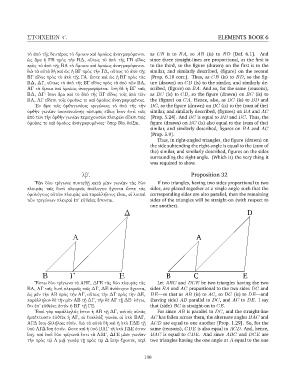
               ῎Εστω δύο τρίγωνα τὰ ΑΒΓ, ΔΓΕ τὰς δύο πλευρὰς τὰς   Let ABC and DCE be two triangles having the two
            ΒΑ, ΑΓ ταῖς δυσὶ πλευραῖς ταῖς ΔΓ, ΔΕ ἀνάλογον ἔχοντα, sides BA and AC proportional to the two sides DC and
            ὡς μὲν τὴν ΑΒ πρὸς τὴν ΑΓ, οὕτως τὴν ΔΓ πρὸς τὴν ΔΕ,  DE—so that as AB (is) to AC, so DC (is) to DE—and
            παράλληλον δὲ τὴν μὲν ΑΒ τῇ ΔΓ, τὴν δὲ ΑΓ τῇ ΔΕ· λέγω, (having side) AB parallel to DC, and AC to DE. I say
            ὅτι ἐπ᾿ εὐθείας ἐστὶν ἡ ΒΓ τῇ ΓΕ.                   that (side) BC is straight-on to CE.
               ᾿Επεὶ γὰρ παράλληλός ἐστιν ἡ ΑΒ τῇ ΔΓ, καὶ εἰς αὐτὰς  For since AB is parallel to DC, and the straight-line
            ἐμπέπτωκεν εὐθεῖα ἡ ΑΓ, αἱ ἐναλλὰξ γωνίαι αἱ ὑπὸ ΒΑΓ, AC has fallen across them, the alternate angles BAC and
            ΑΓΔ ἴσαι ἀλλήλαις εἰσίν. διὰ τὰ αὐτὰ δὴ καὶ ἡ ὑπὸ ΓΔΕ τῇ  ACD are equal to one another [Prop. 1.29]. So, for the
            ὑπὸ ΑΓΔ ἴση ἐστίν. ὥστε καὶ ἡ ὑπὸ ΒΑΓ τῇ ὑπὸ ΓΔΕ ἐστιν same (reasons), CDE is also equal to ACD. And, hence,
            ἴση. καὶ ἐπεὶ δύο τρίγωνά ἐστι τὰ ΑΒΓ, ΔΓΕ μίαν γωνίαν BAC is equal to CDE. And since ABC and DCE are
            τὴν πρὸς τῷ Α μιᾷ γωνίᾳ τῇ πρὸς τῷ Δ ἴσην ἔχοντα, περὶ two triangles having the one angle at A equal to the one


                                                             190

