


Page 191 - Euclid's Elements of Geometry
P. 191
ST	EW      þ.


                                                                                            ELEMENTS BOOK 6


            δὲ τὰς ἴσας γωνίας τὰς πλευρὰς ἀνάλογον, ὡς τὴν ΒΑ πρὸς  angle at D, and the sides about the equal angles pro-
            τὴν ΑΓ, οὕτως τὴν ΓΔ πρὸς τὴν ΔΕ, ἰσογώνιον ἄρα ἐστὶ  portional, (so that) as BA (is) to AC, so CD (is) to
            τὸ ΑΒΓ τρίγωνον τῷ ΔΓΕ τριγώνῳ· ἴση ἄρα ἡ ὑπὸ ΑΒΓ   DE, triangle ABC is thus equiangular to triangle DCE
            γωνία τῇ ὑπὸ ΔΓΕ. ἐδείχθη δὲ καὶ ἡ ὑπὸ ΑΓΔ τῇ ὑπὸ ΒΑΓ  [Prop. 6.6]. Thus, angle ABC is equal to DCE. And (an-
            ἴση· ὅλη ἄρα ἡ ὑπὸ ΑΓΕ δυσὶ ταῖς ὑπὸ ΑΒΓ, ΒΑΓ ἴση ἐστίν. gle) ACD was also shown (to be) equal to BAC. Thus,
            κοινὴ προσκείσθω ἡ ὑπὸ ΑΓΒ· αἱ ἄρα ὑπὸ ΑΓΕ, ΑΓΒ ταῖς the whole (angle) ACE is equal to the two (angles) ABC
            ὑπὸ ΒΑΓ, ΑΓΒ, ΓΒΑ ἴσαι εἰσίν. ἀλλ᾿ αἱ ὑπὸ ΒΑΓ, ΑΒΓ, and BAC. Let ACB have been added to both. Thus,
            ΑΓΒ δυσὶν ὀρθαῖς ἴσαι εἰσίν· καὶ αἱ ὑπὸ ΑΓΕ, ΑΓΒ ἄρα ACE and ACB are equal to BAC, ACB, and CBA.
            δυσὶν ὀρθαῖς ἴσαι εἰσίν. πρὸς δή τινι εὐθείᾳ τῇ ΑΓ καὶ τῷ But, BAC, ABC, and ACB are equal to two right-angles
            πρὸς αὐτῇ σημείῳ τῷ Γ δύο εὐθεῖαι αἱ ΒΓ, ΓΕ μὴ ἐπὶ τὰ  [Prop. 1.32]. Thus, ACE and ACB are also equal to two
            αὐτὰ μέρη κείμεναι τὰς ἐφεξῆς γωνάις τὰς ὑπὸ ΑΓΕ, ΑΓΒ  right-angles. Thus, the two straight-lines BC and CE,
            δυσὶν ὀρθαῖς ἴσας ποιοῦσιν· ἐπ᾿ εὐθείας ἄρα ἐστὶν ἡ ΒΓ τῇ  not lying on the same side, make adjacent angles ACE
            ΓΕ.                                                 and ACB (whose sum is) equal to two right-angles with
                                   lgþ                          that the corresponding sides are also parallel, then the
               ᾿Εὰν ἄρα δύο τρίγωνα συντεθῇ κατὰ μίαν γωνίαν τὰς some straight-line AC, at the point C on it. Thus, BC is
            δύο πλευρὰς ταῖς δυσὶ πλευραῖς ἀνάλογον ἔχοντα ὥστε τὰς straight-on to CE [Prop. 1.14].
            ὁμολόγους αὐτῶν πλευρὰς καὶ παραλλήλους εἶναι, αἱ λοιπαὶ  Thus, if two triangles, having two sides proportional
            τῶν τριγώνων πλευραὶ ἐπ᾿ εὐθείας ἔσονται· ὅπερ ἔδει δεῖξαι. to two sides, are placed together at a single angle such
                                                                remaining sides of the triangles will be straight-on (with
                                                                respect to one another). (Which is) the very thing it was
                                                                required to show.
                                                                                 Proposition 33
                                      .
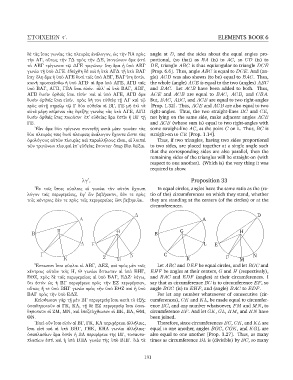
               ᾿Εν τοῖς ἴσοις κύκλοις αἱ γωνίαι τὸν αὐτὸν ἔχουσι   In equal circles, angles have the same ratio as the (ra-
                                                         D
            λόγον ταῖς περιφερείαις, ἐφ᾿ ὧν βεβήκασιν, ἐάν τε πρὸς  tio of the) circumferences on which they stand, whether
                                  A
            τοῖς κέντροις ἐάν τε πρὸς ταῖς περιφερείαις ὦσι βεβηκυῖαι.  they are standing at the centers (of the circles) or at the
                                                                circumferences.
              B          H          E                           B         G         A              H       D


                  G                        Z                                       L    E


                                                                     C
                                                                                                           N
                                                                                                F
                                                                               K
                                                                                                     M
               ῎Εστωσαν ἴσοι κύκλοι οἱ ΑΒΓ, ΔΕΖ, καὶ πρὸς μὲν τοῖς  Let ABC and DEF be equal circles, and let BGC and
            κέντροις αὐτῶν τοῖς Η, Θ γωνίαι ἔστωσαν αἱ ὑπὸ ΒΗΓ, EHF be angles at their centers, G and H (respectively),
            ΕΘΖ, πρὸς δὲ ταῖς περιφερείαις αἱ ὑπὸ ΒΑΓ, ΕΔΖ· λέγω, and BAC and EDF (angles) at their circumferences. I
            ὅτι ἐστὶν ὡς ἡ ΒΓ περιφέρεια πρὸς τὴν ΕΖ περιφέρειαν, say that as circumference BC is to circumference EF, so
            οὕτως ἥ τε ὑπὸ ΒΗΓ γωνία πρὸς τὴν ὑπὸ ΕΘΖ καὶ ἡ ὑπὸ angle BGC (is) to EHF, and (angle) BAC to EDF.
            ΒΑΓ πρὸς τὴν ὑπὸ ΕΔΖ.                                  For let any number whatsoever of consecutive (cir-
               Κείσθωσαν γὰρ τῇ μὲν ΒΓ περιφερείᾳ ἴσαι κατὰ τὸ ἑξῆς cumferences), CK and KL, be made equal to circumfer-
            ὁσαιδηποτοῦν αἱ ΓΚ, ΚΛ, τῇ δὲ ΕΖ περιφερείᾳ ἴσαι ὁσαι- ence BC, and any number whatsoever, FM and MN, to
            δηποτοῦν αἱ ΖΜ, ΜΝ, καὶ ἐπεζεύχθωσαν αἱ ΗΚ, ΗΛ, ΘΜ, circumference EF. And let GK, GL, HM, and HN have
            ΘΝ.                                                 been joined.
               ᾿Επεὶ οὖν ἴσαι εἰσὶν αἱ ΒΓ, ΓΚ, ΚΛ περιφέρειαι ἀλλήλαις,  Therefore, since circumferences BC, CK, and KL are
            ἴσαι εἰσὶ καὶ αἱ ὑπὸ ΒΗΓ, ΓΗΚ, ΚΗΛ γωνίαι ἀλλήλαις· equal to one another, angles BGC, CGK, and KGL are
            ὁσαπλασίων ἄρα ἐστὶν ἡ ΒΛ περιφέρεια τῆς ΒΓ, τοσαυτα- also equal to one another [Prop. 3.27]. Thus, as many
            πλασίων ἐστὶ καὶ ἡ ὑπὸ ΒΗΛ γωνία τῆς ὑπὸ ΒΗΓ. διὰ τὰ  times as circumference BL is (divisible) by BC, so many


                                                             191

