


Page 200 - Euclid's Elements of Geometry
P. 200
ST	EW      zþ.


                                                                                            ELEMENTS BOOK 7


            ἕτερος ὁ Δ ἑτέρου τοῦ ΕΖ τὸ αὐτὸ μέρος, ὅπερ ὁ Α τοῦ another (number) D (be) the same part of another (num-
            ΒΓ· λέγω, ὅτι καὶ συναμφότερος ὁ Α, Δ συναμφοτέρου τοῦ ber) EF that A (is) of BC. I say that the sum A, D is also
            ΒΓ, ΕΖ τὸ αὐτὸ μέρος ἐστίν, ὅπερ ὁ Α τοῦ ΒΓ.        the same part of the sum BC, EF that A (is) of BC.
               ᾿Επεὶ γάρ, ὃ μέρος ἐστὶν ὁ Α τοῦ ΒΓ, τὸ αὐτὸ μέρος ἐστὶ  For since which(ever) part A is of BC, D is the same
            καὶ ὁ Δ τοῦ ΕΖ, ὅσοι ἄρα εἰσὶν ἐν τῷ ΒΓ ἀριθμοὶ ἴσοι τῷ part of EF, thus as many numbers as are in BC equal
            Α, τοσοῦτοί εἰσι καὶ ἐν τῷ ΕΖ ἀριθμοὶ ἴσοι τῷ Δ. διῇρήσθω to A, so many numbers are also in EF equal to D. Let
            ὁ μὲν ΒΓ εἰς τοὺς τῷ Α ἴσους τοὺς ΒΗ, ΗΓ, ὁ δὲ ΕΖ εἰς BC have been divided into BG and GC, equal to A, and
            τοὺς τῷ Δ ἴσους τοὺς ΕΘ, ΘΖ· ἔσται δὴ ἴσον τὸ πλῆθος EF into EH and HF, equal to D. So the multitude of
            τῶν ΒΗ, ΗΓ τῷ πλήθει τῶν ΕΘ, ΘΖ. καὶ ἐπεὶ ἴσος ἐστὶν (divisions) BG, GC will be equal to the multitude of (di-
            ὁ μὲν ΒΗ τῷ Α, ὁ δὲ ΕΘ τῷ Δ, καὶ οἱ ΒΗ, ΕΘ ἄρα τοῖς visions) EH, HF. And since BG is equal to A, and EH
            Α, Δ ἴσοι. διὰ τὰ αὐτὰ δὴ καὶ οἱ ΗΓ, ΘΖ τοῖς Α, Δ. ὅσοι  to D, thus BG, EH (is) also equal to A, D. So, for the
            ἄρα [εἰσὶν] ἐν τῷ ΒΓ ἀριθμοὶ ἴσοι τῷ Α, τοσοῦτοί εἰσι καὶ same (reasons), GC, HF (is) also (equal) to A, D. Thus,
            ἐν τοῖς ΒΓ, ΕΖ ἴσοι τοῖς Α, Δ. ὁσαπλασίων ἄρα ἐστὶν ὁ ΒΓ  as many numbers as [are] in BC equal to A, so many are
                                    þ                          sum BC, EF. (Which is) the very thing it was required
            τοῦ Α, τοσαυταπλασίων ἐστὶ καὶ συναμφότερος ὁ ΒΓ, ΕΖ  also in BC, EF equal to A, D. Thus, as many times as
            συναμφοτέρου τοῦ Α, Δ. ὃ ἄρα μέρος ἐστὶν ὁ Α τοῦ ΒΓ, τὸ  BC is (divisible) by A, so many times is the sum BC, EF
            αὐτὸ μέρος ἐστὶ καὶ συναμφότερος ὁ Α, Δ συναμφοτέρου also (divisible) by the sum A, D. Thus, which(ever) part
            τοῦ ΒΓ, ΕΖ· ὅπερ ἔδει δεῖξαι.                       A is of BC, the sum A, D is also the same part of the
                                                                to show.

            †  In modern notation, this proposition states that if a = (1/n) b and c = (1/n) d then (a+ c) = (1/n) (b+ d), where all symbols denote numbers.

                                                                                 Proposition 6
                                                                                               †
                                      .
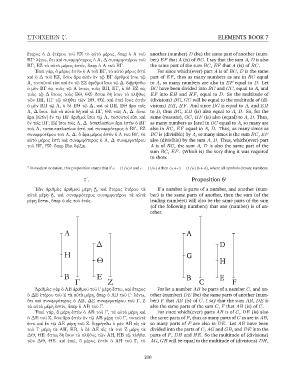
               ᾿Εὰν ἀριθμὸς ἀριθμοῦ μέρη ᾖ, καὶ ἕτερος ἑτέρου τὰ   If a number is parts of a number, and another (num-
            αὐτὰ μέρη ᾖ, καὶ συναμφότερος συναμφοτέρου τὰ αὐτὰ ber) is the same parts of another, then the sum (of the
            μέρη ἔσται, ὅπερ ὁ εἷς τοῦ ἑνός.                    leading numbers) will also be the same parts of the sum
                                                                (of the following numbers) that one (number) is of an-
                                                                other.


                            Α                                                  A

                                         ∆                                                   D

                            Η                                                  G
                                         Θ                                                   H


                            Β            Ε                                     B             E
                                Γ             Ζ                                     C             F
               ᾿Αριθμὸς γὰρ ὁ ΑΒ ἀριθμοῦ τοῦ Γ μέρη ἔστω, καὶ ἕτερος  For let a number AB be parts of a number C, and an-
            ὁ ΔΕ ἑτέρου τοῦ Ζ τὰ αὐτὰ μέρη, ἅπερ ὁ ΑΒ τοῦ Γ· λέγω, other (number) DE (be) the same parts of another (num-
            ὅτι καὶ συναμφότερος ὁ ΑΒ, ΔΕ συναμφοτέρου τοῦ Γ, Ζ  ber) F that AB (is) of C. I say that the sum AB, DE is
            τὰ αὐτὰ μέρη ἐστίν, ἅπερ ὁ ΑΒ τοῦ Γ.                also the same parts of the sum C, F that AB (is) of C.
               ᾿Επεὶ γάρ, ἃ μέρη ἐστὶν ὁ ΑΒ τοῦ Γ, τὰ αὐτὰ μέρη καὶ  For since which(ever) parts AB is of C, DE (is) also
            ὁ ΔΕ τοῦ Ζ, ὅσα ἄρα ἐστὶν ἐν τῷ ΑΒ μέρη τοῦ Γ, τοσαῦτά the same parts of F, thus as many parts of C as are in AB,
            ἐστι καὶ ἐν τῷ ΔΕ μέρη τοῦ Ζ. διῃρήσθω ὁ μὲν ΑΒ εἰς τὰ  so many parts of F are also in DE. Let AB have been
            τοῦ Γ μέρη τὰ ΑΗ, ΗΒ, ὁ δὲ ΔΕ εἰς τὰ τοῦ Ζ μέρη τὰ  divided into the parts of C, AG and GB, and DE into the
            ΔΘ, ΘΕ· ἔσται δὴ ἴσον τὸ πλῆθος τῶν ΑΗ, ΗΒ τῷ πλήθει parts of F, DH and HE. So the multitude of (divisions)
            τῶν ΔΘ, ΘΕ. καὶ ἐπεί, ὃ μέρος ἐστὶν ὁ ΑΗ τοῦ Γ, τὸ  AG, GB will be equal to the multitude of (divisions) DH,


                                                             200

