


Page 201 - Euclid's Elements of Geometry
P. 201
ST	EW      zþ.


                                                                                            ELEMENTS BOOK 7


            αὑτὸ μέρος ἐστὶ καὶ ὁ ΔΘ τοῦ Ζ, ὃ ἄρα μέρος ἐστὶν ὁ ΑΗ  HE. And since which(ever) part AG is of C, DH is also
            τοῦ Γ, τὸ αὐτὸ μέρος ἐστὶ καὶ συναμφότερος ὁ ΑΗ, ΔΘ  the same part of F, thus which(ever) part AG is of C,
            συναμφοτέρου τοῦ Γ, Ζ. διὰ τὰ αὐτὰ δὴ καὶ ὃ μέρος ἐστὶν ὁ  the sum AG, DH is also the same part of the sum C, F
                                    zþ                          (Which is) the very thing it was required to show.
            ΗΒ τοῦ Γ, τὸ αὐτὸ μέρος ἐστὶ καὶ συναμφότερος ὁ ΗΒ, ΘΕ [Prop. 7.5]. And so, for the same (reasons), which(ever)
            συναμφοτέρου τοῦ Γ, Ζ. ἃ ἄρα μέρη ἐστὶν ὁ ΑΒ τοῦ Γ, τὰ  part GB is of C, the sum GB, HE is also the same part
            αὐτὰ μέρη ἐστὶ καὶ συναμφότερος ὁ ΑΒ, ΔΕ συναμφοτέρου of the sum C, F. Thus, which(ever) parts AB is of C,
            τοῦ Γ, Ζ· ὅπερ ἔδει δεῖξαι.                         the sum AB, DE is also the same parts of the sum C, F.


            †  In modern notation, this proposition states that if a = (m/n) b and c = (m/n) d then (a + c) = (m/n) (b + d), where all symbols denote
            numbers.

                                      .
                                                                                               †
                                                                                 Proposition 7
               ᾿Εὰν ἀριθμὸς ἀριθμοῦ μέρος ᾖ, ὅπερ ἀφαιρεθεὶς ἀφαι-  If a number is that part of a number that a (part)
            ρεθέντος, καὶ ὁ λοιπὸς τοῦ λοιποῦ τὸ αὐτὸ μέρος ἔσται, taken away (is) of a (part) taken away then the remain-
            ὅπερ ὁ ὅλος τοῦ ὅλου.                               der will also be the same part of the remainder that the
                                                                whole (is) of the whole.
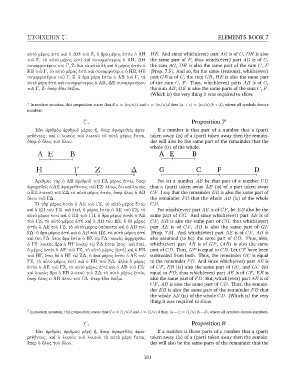
                 Α Ε          Β                                     A   E        B


                Η               Γ        Ζ              ∆           G              C        F              D

               ᾿Αριθμὸς γὰρ ὁ ΑΒ ἀριθμοῦ τοῦ ΓΔ μέρος ἔστω, ὅπερ   For let a number AB be that part of a number CD
            ἀφαιρεθεὶς ὁ ΑΕ ἀφαιρεθέντος τοῦ ΓΖ· λέγω, ὅτι καὶ λοιπὸς that a (part) taken away AE (is) of a part taken away
            ὁ ΕΒ λοιποῦ τοῦ ΖΔ τὸ αὐτὸ μέρος ἐστίν, ὅπερ ὅλος ὁ ΑΒ  CF. I say that the remainder EB is also the same part of
            ὅλου τοῦ ΓΔ.                                        the remainder FD that the whole AB (is) of the whole
               ῝Ο γὰρ μέρος ἐστὶν ὁ ΑΕ τοῦ ΓΖ, τὸ αὐτὸ μέρος ἔστω CD.
            καὶ ὁ ΕΒ τοῦ ΓΗ. καὶ ἐπεί, ὃ μέρος ἐστὶν ὁ ΑΕ τοῦ ΓΖ, τὸ  For which(ever) part AE is of CF, let EB also be the
            αὐτὸ μέρος ἐστὶ καὶ ὁ ΕΒ τοῦ ΓΗ, ὃ ἄρα μέρος ἐστὶν ὁ ΑΕ  same part of CG. And since which(ever) part AE is of
            τοῦ ΓΖ, τὸ αὐτὸ μέρος ἐστὶ καὶ ὁ ΑΒ τοῦ ΗΖ. ὃ δὲ μέρος  CF, EB is also the same part of CG, thus which(ever)
            ἐστὶν ὁ ΑΕ τοῦ ΓΖ, τὸ αὐτὸ μέρος ὑπόκειται καὶ ὁ ΑΒ τοῦ part AE is of CF, AB is also the same part of GF
            ΓΔ· ὃ ἄρα μέρος ἐστὶ καὶ ὁ ΑΒ τοῦ ΗΖ, τὸ αὐτὸ μέρος ἐστὶ  [Prop. 7.5]. And which(ever) part AE is of CF, AB is
            καὶ τοῦ ΓΔ· ἴσος ἄρα ἐστὶν ὁ ΗΖ τῷ ΓΔ. κοινὸς ἀφῃρήσθω also assumed (to be) the same part of CD. Thus, also,
            ὁ ΓΖ· λοιπὸς ἄρα ὁ ΗΓ λοιπῷ τῷ ΖΔ ἐστιν ἴσος. καὶ ἐπεί, which(ever) part AB is of GF, (AB) is also the same
            ὃ μέρος ἐστὶν ὁ ΑΕ τοῦ ΓΖ, τὸ αὐτὸ μέρος [ἐστὶ] καὶ ὁ ΕΒ  part of CD. Thus, GF is equal to CD. Let CF have been
            τοῦ ΗΓ, ἴσος δὲ ὁ ΗΓ τῷ ΖΔ, ὃ ἄρα μέρος ἐστὶν ὁ ΑΕ τοῦ subtracted from both. Thus, the remainder GC is equal
            ΓΖ, τὸ αὐτὸ μέρος ἐστὶ καὶ ὁ ΕΒ τοῦ ΖΔ. ἀλλὰ ὃ μέρος  to the remainder FD. And since which(ever) part AE is
            ἐστὶν ὁ ΑΕ τοῦ ΓΖ, τὸ αὐτὸ μέρος ἐστὶ καὶ ὁ ΑΒ τοῦ ΓΔ· of CF, EB [is] also the same part of GC, and GC (is)
                                    hþ                          der EB is also the same part of the remainder FD that
            καὶ λοιπὸς ἄρα ὁ ΕΒ λοιποῦ τοῦ ΖΔ τὸ αὐτὸ μέρος ἐστίν, equal to FD, thus which(ever) part AE is of CF, EB is
            ὅπερ ὅλος ὁ ΑΒ ὅλου τοῦ ΓΔ· ὅπερ ἔδει δεῖξαι.       also the same part of FD. But, which(ever) part AE is of
                                                                CF, AB is also the same part of CD. Thus, the remain-
                                                                the whole AB (is) of the whole CD. (Which is) the very
                                                                thing it was required to show.

            †  In modern notation, this proposition states that if a = (1/n) b and c = (1/n) d then (a− c) = (1/n) (b− d), where all symbols denote numbers.

                                                                                 Proposition 8
                                                                                               †
                                      .
               ᾿Εὰν ἀριθμὸς ἀριθμοῦ μέρη ᾖ, ἅπερ ἀφαιρεθεὶς ἀφαι-  If a number is those parts of a number that a (part)
            ρεθέντος, καὶ ὁ λοιπὸς τοῦ λοιποῦ τὰ αὐτὰ μέρη ἔσται, taken away (is) of a (part) taken away then the remain-
            ἅπερ ὁ ὅλος τοῦ ὅλου.                               der will also be the same parts of the remainder that the

                                                             201

