


Page 216 - Euclid's Elements of Geometry
P. 216
ST	EW      zþ.     kzþ


                                                                                            ELEMENTS BOOK 7


                                                                                Proposition 27
                                                                                                †
                                      .
               ᾿Εὰν δύο ἀριθμοὶ πρῶτοι πρὸς ἀλλήλους ὦσιν, καὶ πολ-  If two numbers are prime to one another and each
            λαπλασιάσας ἑκάτερος ἑαυτὸν ποιῇ τινα, οἱ γενόμενοι ἐξ makes some (number by) multiplying itself then the num-
            αὐτῶν πρῶτοι πρὸς ἀλλήλους ἔσονται, κἂν οἱ ἐξ ἀρχῆς bers created from them will be prime to one another, and
            τοὺς γενομένους πολλαπλασιάσαντες ποιῶσί τινας, κἀκεῖνοι if the original (numbers) make some (more numbers by)
            πρῶτοι πρὸς ἀλλήλους ἔσονται [καὶ ἀεὶ περὶ τοὺς ἄκρους multiplying the created (numbers) then these will also be
            τοῦτο συμβαίνει].                                   prime to one another [and this always happens with the
                                                                extremes].
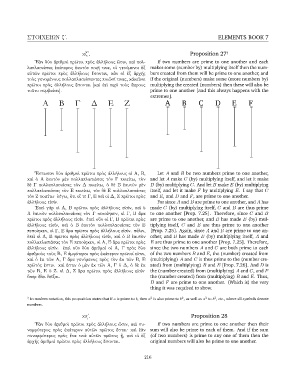
                   Α      Β     Γ      ∆      Ε      Ζ                A      B      C      D      E      F


               ῎Εστωσαν δύο ἀριθμοὶ πρῶτοι πρὸς ἀλλήλους οἱ Α, Β,  Let A and B be two numbers prime to one another,
            καὶ ὁ Α ἑαυτὸν μὲν πολλαπλασιάσας τὸν Γ ποιείτω, τὸν and let A make C (by) multiplying itself, and let it make
            δὲ Γ πολλαπλασιάσας τὸν Δ ποιείτω, ὁ δὲ Β ἑαυτὸν μὲν D (by) multiplying C. And let B make E (by) multiplying
            πολλαπλασιάσας τὸν Ε ποιείτω, τὸν δὲ Ε πολλαπλασιάσας itself, and let it make F by multiplying E. I say that C
            τὸν Ζ ποιείτω· λέγω, ὅτι οἵ τε Γ, Ε καὶ οἱ Δ, Ζ πρῶτοι πρὸς  and E, and D and F, are prime to one another.
            ἀλλήλους εἰσίν.                                        For since A and B are prime to one another, and A has
               ᾿Επεὶ γὰρ οἱ Α, Β πρῶτοι πρὸς ἀλλήλους εἰσίν, καὶ ὁ  made C (by) multiplying itself, C and B are thus prime
            Α ἑαυτὸν πολλαπλασιάσας τὸν Γ πεποίηκεν, οἱ Γ, Β ἄρα to one another [Prop. 7.25]. Therefore, since C and B
            πρῶτοι πρὸς ἀλλήλους εἰσίν. ἐπεὶ οὖν οἱ Γ, Β πρῶτοι πρὸς  are prime to one another, and B has made E (by) mul-
            ἀλλήλους εἰσίν, καὶ ὁ Β ἑαυτὸν πολλαπλασιάσας τὸν Ε  tiplying itself, C and E are thus prime to one another
            πεποίηκεν, οἱ Γ, Ε ἄρα πρῶτοι πρὸς ἀλλήλους εἰσίν. πάλιν, [Prop. 7.25]. Again, since A and B are prime to one an-
            ἐπεὶ οἱ Α, Β πρῶτοι πρὸς ἀλλήλους εἰσίν, καὶ ὁ Β ἑαυτὸν other, and B has made E (by) multiplying itself, A and
            πολλαπλασιάσας τὸν Ε πεποίηκεν, οἱ Α, Ε ἄρα πρῶτοι πρὸς  E are thus prime to one another [Prop. 7.25]. Therefore,
            ἀλλήλους εἰσίν. ἐπεὶ οὖν δύο ἀριθμοὶ οἱ Α, Γ πρὸς δύο  since the two numbers A and C are both prime to each
            ἀριθμοὺς τοὺς Β, Ε ἀμφότεροι πρὸς ἑκάτερον πρῶτοί εἰσιν, of the two numbers B and E, the (number) created from
            καὶ ὁ ἐκ τῶν Α, Γ ἄρα γενόμενος πρὸς τὸν ἐκ τῶν Β, Ε  (multiplying) A and C is thus prime to the (number cre-
                                   khþ                          thing it was required to show.
            πρῶτός ἐστιν. καί ἐστιν ὁ μὲν ἐκ τῶν Α, Γ ὁ Δ, ὁ δὲ ἐκ  ated) from (multiplying) B and E [Prop. 7.26]. And D is
            τῶν Β, Ε ὁ Ζ. οἱ Δ, Ζ ἄρα πρῶτοι πρὸς ἀλλήλους εἰσίν· the (number created) from (multiplying) A and C, and F
            ὅπερ ἔδει δεῖξαι.                                   the (number created) from (multiplying) B and E. Thus,
                                                                D and F are prime to one another. (Which is) the very


                                                                                       3
                                                                2
                                                                             2
                                                                                           3
            †  In modern notation, this proposition states that if a is prime to b, then a is also prime to b , as well as a to b , etc., where all symbols denote
            numbers.
                                                                                 Proposition 28
                                      .
               ᾿Εὰν δύο ἀριθμοὶ πρῶτοι πρὸς ἀλλήλους ὦσιν, καὶ συ-  If two numbers are prime to one another then their
            ναμφότερος πρὸς ἑκάτερον αὐτῶν πρῶτος ἔσται· καὶ ἐὰν sum will also be prime to each of them. And if the sum
            συναμφότερος πρὸς ἕνα τινὰ αὐτῶν πρῶτος ᾖ, καὶ οἱ ἐξ (of two numbers) is prime to any one of them then the
            ἀρχῆς ἀριθμοὶ πρῶτοι πρὸς ἀλλήλους ἔσονται.         original numbers will also be prime to one another.


                                                             216

