


Page 221 - Euclid's Elements of Geometry
P. 221
ST	EW      zþ.


                                                                                            ELEMENTS BOOK 7


            ὃν ἐλάχιστον μετροῦσιν ἀριθμόν.                     quired to find the least number which they (both) mea-
                                                                sure.
                Α                     Β                            A                     B

                Γ                                                  C

                ∆                                                  D

                Ε                     Ζ                            E                     F
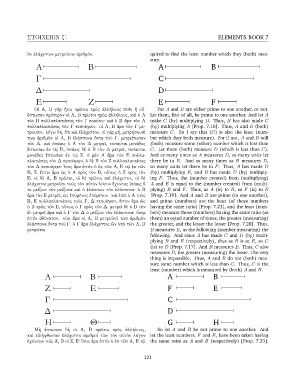
               Οἱ Α, Β γὰρ ἤτοι πρῶτοι πρὸς ἀλλήλους εἰσὶν ἢ οὔ.   For A and B are either prime to one another, or not.
            ἔστωσαν πρότερον οἱ Α, Β πρῶτοι πρὸς ἀλλήλους, καὶ ὁ Α Let them, first of all, be prime to one another. And let A
            τὸν Β πολλαπλασιάσας τὸν Γ ποιείτω· καὶ ὁ Β ἄρα τὸν Α make C (by) multiplying B. Thus, B has also made C
            πολλαπλασιάσας τὸν Γ πεποίηκεν. οἱ Α, Β ἄρα τὸν Γ με-  (by) multiplying A [Prop. 7.16]. Thus, A and B (both)
            τροῦσιν. λέγω δή, ὅτι καὶ ἐλάχιστον. εἰ γὰρ μή, μετρήσουσί measure C. So I say that (C) is also the least (num-
            τινα ἀριθμὸν οἱ Α, Β ἐλάσσονα ὄντα τοῦ Γ. μετρείτωσαν ber which they both measure). For if not, A and B will
            τὸν Δ. καὶ ὁσάκις ὁ Α τὸν Δ μετρεῖ, τοσαῦται μονάδες  (both) measure some (other) number which is less than
            ἔστωσαν ἐν τῷ Ε, ὁσάκις δὲ ὁ Β τὸν Δ μετρεῖ, τοσαῦται C. Let them (both) measure D (which is less than C).
            μονάδες ἔστωσαν ἐν τῷ Ζ. ὁ μὲν Α ἄρα τὸν Ε πολλα- And as many times as A measures D, so many units let
            πλασιάσας τὸν Δ πεποίηκεν, ὁ δὲ Β τὸν Ζ πολλαπλασιάσας there be in E. And as many times as B measures D,
            τὸν Δ πεποίηκεν· ἴσος ἄρα ἐστὶν ὁ ἐκ τῶν Α, Ε τῷ ἐκ τῶν  so many units let there be in F. Thus, A has made D
            Β, Ζ. ἔστιν ἄρα ὡς ὁ Α πρὸς τὸν Β, οὕτως ὁ Ζ πρὸς τὸν (by) multiplying E, and B has made D (by) multiply-
            Ε. οἱ δὲ Α, Β πρῶτοι, οἱ δὲ πρῶτοι καὶ ἐλάχιστοι, οἱ δὲ  ing F. Thus, the (number created) from (multiplying)
            ἐλάχιστοι μετροῦσι τοὺς τὸν αὐτὸν λόγον ἔχοντας ἰσάκις ὅ  A and E is equal to the (number created) from (multi-
            τε μείζων τὸν μείζονα καὶ ὁ ἐλάσσων τὸν ἐλάσσονα· ὁ Β  plying) B and F. Thus, as A (is) to B, so F (is) to E
            ἄρα τὸν Ε μετρεῖ, ὡς ἑπόμενος ἑπόμενον. καὶ ἐπεὶ ὁ Α τοὺς [Prop. 7.19]. And A and B are prime (to one another),
            Β, Ε πολλαπλασιάσας τοὺς Γ, Δ πεποίηκεν, ἔστιν ἄρα ὡς  and prime (numbers) are the least (of those numbers
            ὁ Β πρὸς τὸν Ε, οὕτως ὁ Γ πρὸς τὸν Δ. μετρεῖ δὲ ὁ Β τὸν having the same ratio) [Prop. 7.21], and the least (num-
            Ε· μετρεῖ ἄρα καὶ ὁ Γ τὸν Δ ὁ μείζων τὸν ἐλάσσονα· ὅπερ bers) measure those (numbers) having the same ratio (as
            ἐστὶν ἀδύνατον. οὐκ ἄρα οἱ Α, Β μετροῦσί τινα ἀριθμὸν them) an equal number of times, the greater (measuring)
            ἐλάσσονα ὄντα τοῦ Γ. ὁ Γ ἄρα ἐλάχιστος ὢν ὑπὸ τῶν Α, Β  the greater, and the lesser the lesser [Prop. 7.20]. Thus,
            μετρεῖται.                                          B measures E, as the following (number measuring) the
                                                                following. And since A has made C and D (by) multi-
                                                                plying B and E (respectively), thus as B is to E, so C
                                                                (is) to D [Prop. 7.17]. And B measures E. Thus, C also
                                                                measures D, the greater (measuring) the lesser. The very
                                                                thing is impossible. Thus, A and B do not (both) mea-
                                                                sure some number which is less than C. Thus, C is the
                                                                least (number) which is measured by (both) A and B.
                    Α                  Β                               A                  B

                    Ζ                  Ε                               F                  E

                    Γ                                                  C

                    ∆                                                  D

                    Η                  Θ                               G                  H
               Μὴ ἔστωσαν δὴ οἱ Α, Β πρῶτοι πρὸς ἀλλήλους,         So let A and B be not prime to one another. And
            καὶ εἰλήφθωσαν ἐλάχιστοι ἀριθμοὶ τῶν τὸν αὐτὸν λόγον let the least numbers, F and E, have been taken having
            ἐχόντων τοῖς Α, Β οἱ Ζ, Ε· ἴσος ἄρα ἐστὶν ὁ ἐκ τῶν Α, Ε τῷ the same ratio as A and B (respectively) [Prop. 7.33].


                                                             221

