


Page 228 - Euclid's Elements of Geometry
P. 228
ST	EW      hþ.      aþ                                                      ELEMENTS BOOK 8


                                                                                  Proposition 1
                                      .
               ᾿Εὰν ὦσιν ὁσοιδηποτοῦν ἀριθμοὶ ἑξῆς ἀνάλογον, οἱ δὲ  If there are any multitude whatsoever of continuously
            ἄκροι αὐτῶν πρῶτοι πρὸς ἀλλήλους ὦσιν, ἐλάχιστοί εἰσι proportional numbers, and the outermost of them are
            τῶν τὸν αὐτὸν λόγον ἐχόντων αὐτοῖς.                 prime to one another, then the (numbers) are the least
                                                                of those (numbers) having the same ratio as them.
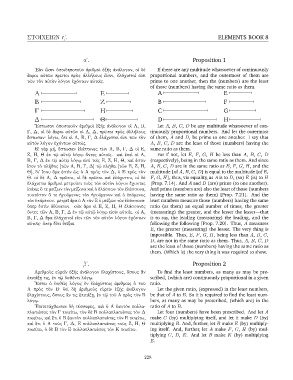
                Α                          Ε                       A                           E
                Β                          Ζ                       B                           F
                Γ                          Η                       C                           G
                ∆                          Θ                       D                           H
               ῎Εστωσαν ὁποσοιοῦν ἀριθμοὶ ἑξῆς ἀνάλογον οἱ Α, Β,   Let A, B, C, D be any multitude whatsoever of con-
            Γ, Δ, οἱ δὲ ἄκροι αὐτῶν οἱ Α, Δ, πρῶτοι πρὸς ἀλλήλους tinuously proportional numbers. And let the outermost
            ἔστωσαν· λέγω, ὅτι οἱ Α, Β, Γ, Δ ἐλάχιστοί εἰσι τῶν τὸν of them, A and D, be prime to one another. I say that
            αὐτὸν λόγον ἐχόντων αὐτοῖς.                         A, B, C, D are the least of those (numbers) having the
               Εἰ γὰρ μή, ἔστωσαν ἐλάττονες τῶν Α, Β, Γ, Δ οἱ Ε,  same ratio as them.
            Ζ, Η, Θ ἐν τῷ αὐτῷ λόγῳ ὄντες αὐτοῖς. καὶ ἐπεὶ οἱ Α,   For if not, let E, F, G, H be less than A, B, C, D
            Β, Γ, Δ ἐν τῷ αὐτῷ λόγῳ εἰσὶ τοῖς Ε, Ζ, Η, Θ, καί ἐστιν (respectively), being in the same ratio as them. And since
            ἴσον τὸ πλῆθος [τῶν Α, Β, Γ, Δ] τῷ πλήθει [τῶν Ε, Ζ, Η, A, B, C, D are in the same ratio as E, F, G, H, and the
            Θ], δι᾿ ἴσου ἄρα ἐστὶν ὡς ὁ Α πρὸς τὸν Δ, ὁ Ε πρὸς τὸν multitude [of A, B, C, D] is equal to the multitude [of E,
            Θ. οἱ δὲ Α, Δ πρῶτοι, οἱ δὲ πρῶτοι καὶ ἐλάχιστοι, οἱ δὲ  F, G, H], thus, via equality, as A is to D, (so) E (is) to H
            ἐλάχιστοι ἀριθμοὶ μετροῦσι τοὺς τὸν αὐτὸν λόγον ἔχοντας [Prop. 7.14]. And A and D (are) prime (to one another).
            ἰσάκις ὅ τε μείζων τὸν μείζονα καὶ ὁ ἐλάσσων τὸν ἐλάσσονα, And prime (numbers are) also the least of those (numbers
            τουτέστιν ὅ τε ἡγούμενος τὸν ἡγούμενον καὶ ὁ ἑπόμενος having the same ratio as them) [Prop. 7.21]. And the
            τὸν ἑπόμενον. μετρεῖ ἄρα ὁ Α τὸν Ε ὁ μείζων τὸν ἐλάσσονα· least numbers measure those (numbers) having the same
            ὅπερ ἐστὶν ἀδύνατον. οὐκ ἄρα οἱ Ε, Ζ, Η, Θ ἐλάσσονες ratio (as them) an equal number of times, the greater
                                    bþ                          impossible. Thus, E, F, G, H, being less than A, B, C,
            ὄντες τῶν Α, Β, Γ, Δ ἐν τῷ αὐτῷ λόγῳ εἰσὶν αὐτοῖς. οἱ Α, (measuring) the greater, and the lesser the lesser—that
            Β, Γ, Δ ἄρα ἐλάχιστοί εἰσι τῶν τὸν αὐτὸν λόγον ἐχόντων is to say, the leading (measuring) the leading, and the
            αὐτοῖς· ὅπερ ἔδει δεῖξαι.                           following the following [Prop. 7.20]. Thus, A measures
                                                                E, the greater (measuring) the lesser. The very thing is

                                                                D, are not in the same ratio as them. Thus, A, B, C, D
                                                                are the least of those (numbers) having the same ratio as
                                                                them. (Which is) the very thing it was required to show.

                                      .
                                                                                  Proposition 2
               Αριθμοὺς εὑρεῖν ἑξῆς ἀνάλογον ἐλαχίστους, ὅσους ἂν  To find the least numbers, as many as may be pre-
            ἐπιτάξῃ τις, ἐν τῷ δοθέντι λόγῳ.                    scribed, (which are) continuously proportional in a given
               ῎Εστω ὁ δοθεὶς λόγος ἐν ἐλάχίστοις ἀριθμοῖς ὁ τοῦ ratio.
            Α πρὸς τὸν Β· δεῖ δὴ ἀριθμοὺς εὑρεῖν ἑξῆς ἀνάλογον     Let the given ratio, (expressed) in the least numbers,
            ἐλαχίστους, ὅσους ἄν τις ἐπιτάξῃ, ἐν τῷ τοῦ Α πρὸς τὸν Β  be that of A to B. So it is required to find the least num-
            λόγῳ.                                               bers, as many as may be prescribed, (which are) in the
               ᾿Επιτετάχθωσαν δὴ τέσσαρες, καὶ ὁ Α ἑαυτὸν πολλα- ratio of A to B.
            πλασιάσας τὸν Γ ποιείτω, τὸν δὲ Β πολλαπλασιάσας τὸν Δ  Let four (numbers) have been prescribed. And let A
            ποιείτω, καὶ ἔτι ὁ Β ἑαυτὸν πολλαπλασιάσας τὸν Ε ποιείτω, make C (by) multiplying itself, and let it make D (by)
            καὶ ἔτι ὁ Α τοὺς Γ, Δ, Ε πολλαπλασιάσας τοὺς Ζ, Η, Θ  multiplying B. And, further, let B make E (by) multiply-
            ποιείτω, ὁ δὲ Β τὸν Ε πολλαπλασιάσας τὸν Κ ποιείτω.  ing itself. And, further, let A make F, G, H (by) mul-
                                                                tiplying C, D, E. And let B make K (by) multiplying
                                                                E.


                                                             228

