


Page 233 - Euclid's Elements of Geometry
P. 233
ST	EW      hþ.


                                                                                            ELEMENTS BOOK 8


            Ν, Ξ, Μ, Ο ἐλάσσονες ἀριθμοὶ ἑξῆς ἀνάλογον ἔν τε τοῖς K also measures S [Def. 7.20]. And E also measures
            τοῦ Α πρὸς τὸν Β καὶ τοῦ Γ πρὸς τὸν Δ καὶ ἔτι τοῦ Ε πρὸς  S [Prop. 7.20]. Thus, E and K (both) measure S. Thus,
            τὸν Ζ λόγοις· οἱ Ν, Ξ, Μ, Ο ἄρα ἑξῆς ἀνάλογον ἐλάχιστοί the least (number) measured by (both) E and K will also
            εἰσιν ἐν τοῖς Α Β, Γ Δ, Ε Ζ λόγοις· ὅπερ ἔδει δεῖξαι.  measure S [Prop. 7.35]. And M is the least (number)
                                    eþ                          sible. Thus there cannot be any numbers less than N, O,
                                                                measured by (both) E and K. Thus, M measures S, the
                                                                greater (measuring) the lesser. The very thing is impos-

                                                                M, P (which are) continuously proportional in the ratios
                                                                of A to B, and of C to D, and, further, of E to F. Thus,
                                                                N, O, M, P are the least (numbers) continuously propor-
                                                                tional in the ratios of A B, C D, E F. (Which is) the very
                                                                thing it was required to show.

                                                                                  Proposition 5
                                      .
               Οἱ ἐπίπεδοι ἀριθμοὶ πρὸς ἀλλήλους λόγον ἔχουσι τὸν  Plane numbers have to one another the ratio compoun-
                                                                   †
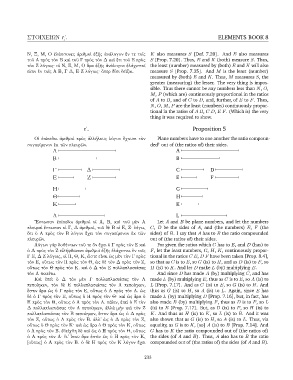
            συγκείμενον ἐκ τῶν πλευρῶν.                         ded out of (the ratios of) their sides.
                       Α                                                   A
                       Β                                                   B

                       Γ             ∆                                     C             D
                       Ε             Ζ                                     E             F

                       Η                                                   G
                       Θ                                                   H
                       Κ                                                   K

                       Λ                                                   L
               ῎Εστωσαν ἐπίπεδοι ἀριθμοὶ οἱ Α, Β, καὶ τοῦ μὲν Α    Let A and B be plane numbers, and let the numbers
            πλευραὶ ἔστωσαν οἱ Γ, Δ ἀριθμοί, τοῦ δὲ Β οἱ Ε, Ζ· λέγω, C, D be the sides of A, and (the numbers) E, F (the
            ὅτι ὁ Α πρὸς τὸν Β λόγον ἔχει τὸν συγκείμενον ἐκ τῶν  sides) of B. I say that A has to B the ratio compounded
            πλευρῶν.                                            out of (the ratios of) their sides.
               Λόγων γὰρ δοθέντων τοῦ τε ὃν ἔχει ὁ Γ πρὸς τὸν Ε καὶ  For given the ratios which C has to E, and D (has) to
            ὁ Δ πρὸς τὸν Ζ εἰλήφθωσαν ἀριθμοὶ ἑξῆς ἐλάχιστοι ἐν τοῖς F, let the least numbers, G, H, K, continuously propor-
            Γ Ε, Δ Ζ λόγοις, οἱ Η, Θ, Κ, ὥστε εἶναι ὡς μὲν τὸν Γ πρὸς  tional in the ratios C E, D F have been taken [Prop. 8.4],
            τὸν Ε, οὕτως τὸν Η πρὸς τὸν Θ, ὡς δὲ τὸν Δ πρὸς τὸν Ζ, so that as C is to E, so G (is) to H, and as D (is) to F, so
            οὕτως τὸν Θ πρὸς τὸν Κ. καὶ ὁ Δ τὸν Ε πολλαπλασιάσας H (is) to K. And let D make L (by) multiplying E.
            τὸν Λ ποιείτω.                                         And since D has made A (by) multiplying C, and has
               Καὶ ἐπεὶ ὁ Δ τὸν μὲν Γ πολλαπλασιάσας τὸν Α made L (by) multiplying E, thus as C is to E, so A (is) to
            πεποίηκεν, τὸν δὲ Ε πολλαπλασιάσας τὸν Λ πεποίηκεν, L [Prop. 7.17]. And as C (is) to E, so G (is) to H. And
            ἔστιν ἄρα ὡς ὁ Γ πρὸς τὸν Ε, οὕτως ὁ Α πρὸς τὸν Λ. ὡς  thus as G (is) to H, so A (is) to L. Again, since E has
            δὲ ὁ Γ πρὸς τὸν Ε, οὕτως ὁ Η πρὸς τὸν Θ· καὶ ὡς ἄρα ὁ  made L (by) multiplying D [Prop. 7.16], but, in fact, has
            Η πρὸς τὸν Θ, οὕτως ὁ Α πρὸς τὸν Λ. πάλιν, ἐπεὶ ὁ Ε τὸν also made B (by) multiplying F, thus as D is to F, so L
            Δ πολλαπλασιάσας τὸν Λ πεποίηκεν, ἀλλὰ μὴν καὶ τὸν Ζ  (is) to B [Prop. 7.17]. But, as D (is) to F, so H (is) to
            πολλαπλασιάσας τὸν Β πεποίηκεν, ἔστιν ἄρα ὡς ὁ Δ πρὸς  K. And thus as H (is) to K, so L (is) to B. And it was
            τὸν Ζ, οὕτως ὁ Λ πρὸς τὸν Β. ἀλλ᾿ ὡς ὁ Δ πρὸς τὸν Ζ, also shown that as G (is) to H, so A (is) to L. Thus, via
            οὕτως ὁ Θ πρὸς τὸν Κ· καὶ ὡς ἄρα ὁ Θ πρὸς τὸν Κ, οὕτως equality, as G is to K, [so] A (is) to B [Prop. 7.14]. And
            ὁ Λ πρὸς τὸν Β. ἐδείχθη δὲ καὶ ὡς ὁ Η πρὸς τὸν Θ, οὕτως G has to K the ratio compounded out of (the ratios of)
            ὁ Α πρὸς τὸν Λ· δι᾿ ἴσου ἄρα ἐστὶν ὡς ὁ Η πρὸς τὸν Κ, the sides (of A and B). Thus, A also has to B the ratio
            [οὕτως] ὁ Α πρὸς τὸν Β. ὁ δὲ Η πρὸς τὸν Κ λόγον ἔχει compounded out of (the ratios of) the sides (of A and B).

                                                             233

