


Page 239 - Euclid's Elements of Geometry
P. 239
ST	EW      hþ.


            δεῖξαι.                 iaþ                                                     ELEMENTS BOOK 8
                                      .
                                                                                 Proposition 11
               Δύο τετραγώνων ἀριθμῶν εἷς μέσος ἀνάλογόν ἐστιν     There exists one number in mean proportion to two
                                                                                      †
            ἀριθμός, καὶ ὁ τετράγωνος πρὸς τὸν τετράγωνον δι-   (given) square numbers. And (one) square (number)
                                                                                                       ‡
            πλασίονα λόγον ἔχει ἤπερ ἡ πλευρὰ πρὸς τὴν πλευράν.  has to the (other) square (number) a squared ratio with
                                                                respect to (that) the side (of the former has) to the side
                                                                (of the latter).
                     Α                                                  A

                     Β                                                  B

                     Γ             ∆                                    C              D

                     Ε                                                  E
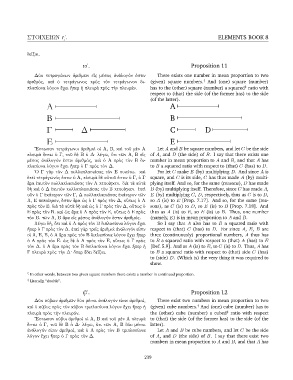
               ῎Εστωσαν τετράγωνοι ἀριθμοὶ οἱ Α, Β, καὶ τοῦ μὲν Α  Let A and B be square numbers, and let C be the side
            πλευρὰ ἔστω ὁ Γ, τοῦ δὲ Β ὁ Δ· λέγω, ὅτι τῶν Α, Β εἷς of A, and D (the side) of B. I say that there exists one
            μέσος ἀνάλογόν ἐστιν ἀριθμός, καὶ ὁ Α πρὸς τὸν Β δι-  number in mean proportion to A and B, and that A has
            πλασίονα λόγον ἔχει ἤπερ ὁ Γ πρὸς τὸν Δ.            to B a squared ratio with respect to (that) C (has) to D.
               ῾Ο Γ γὰρ τὸν Δ πολλαπλασιάσας τὸν Ε ποιείτω. καὶ    For let C make E (by) multiplying D. And since A is
            ἐπεὶ τετράγωνός ἐστιν ὁ Α, πλευρὰ δὲ αὐτοῦ ἐστιν ὁ Γ, ὁ Γ  square, and C is its side, C has thus made A (by) multi-
            ἄρα ἑαυτὸν πολλαπλασιάσας τὸν Α πεποίηκεν. διὰ τὰ αὐτὰ plying itself. And so, for the same (reasons), D has made
            δὴ καὶ ὁ Δ ἑαυτὸν πολλαπλασιάσας τὸν Β πεποίηκεν. ἐπεὶ B (by) multiplying itself. Therefore, since C has made A,
            οὖν ὁ Γ ἑκάτερον τῶν Γ, Δ πολλαπλασιάσας ἑκάτερον τῶν  E (by) multiplying C, D, respectively, thus as C is to D,
            Α, Ε πεποίηκεν, ἔστιν ἄρα ὡς ὁ Γ πρὸς τὸν Δ, οὕτως ὁ Α so A (is) to E [Prop. 7.17]. And so, for the same (rea-
            πρὸς τὸν Ε. διὰ τὰ αὐτὰ δὴ καὶ ὡς ὁ Γ πρὸς τὸν Δ, οὕτως ὁ  sons), as C (is) to D, so E (is) to B [Prop. 7.18]. And
            Ε πρὸς τὸν Β. καὶ ὡς ἄρα ὁ Α πρὸς τὸν Ε, οὕτως ὁ Ε πρὸς  thus as A (is) to E, so E (is) to B. Thus, one number
            τὸν Β. τῶν Α, Β ἄρα εἷς μέσος ἀνάλογόν ἐστιν ἀριθμός.  (namely, E) is in mean proportion to A and B.
               Λέγω δή, ὅτι καὶ ὁ Α πρὸς τὸν Β διπλασίονα λόγον ἔχει  So I say that A also has to B a squared ratio with
            ἤπερ ὁ Γ πρὸς τὸν Δ. ἐπεὶ γὰρ τρεῖς ἀριθμοὶ ἀνάλογόν εἰσιν respect to (that) C (has) to D. For since A, E, B are
            οἱ Α, Ε, Β, ὁ Α ἄρα πρὸς τὸν Β διπλασίονα λόγον ἔχει ἤπερ three (continuously) proportional numbers, A thus has
                                    ibþ                         show.
            ὁ Α πρὸς τὸν Ε. ὡς δὲ ὁ Α πρὸς τὸν Ε, οὕτως ὁ Γ πρὸς  to B a squared ratio with respect to (that) A (has) to E
            τὸν Δ. ὁ Α ἄρα πρὸς τὸν Β διπλασίονα λόγον ἔχει ἤπερ ἡ  [Def. 5.9]. And as A (is) to E, so C (is) to D. Thus, A has
            Γ πλευρὰ πρὸς τὴν Δ· ὅπερ ἔδει δεῖξαι.              to B a squared ratio with respect to (that) side C (has)
                                                                to (side) D. (Which is) the very thing it was required to


            †  In other words, between two given square numbers there exists a number in continued proportion.
            ‡  Literally, “double”.

                                                                                 Proposition 12
                                      .
               Δύο κύβων ἀριθμῶν δύο μέσοι ἀνάλογόν εἰσιν ἀριθμοί,  There exist two numbers in mean proportion to two
                                                                                   †
            καὶ ὁ κύβος πρὸς τὸν κύβον τριπλασίονα λόγον ἔχει ἤπερ ἡ  (given) cube numbers. And (one) cube (number) has to
                                                                                                ‡
            πλευρὰ πρὸς τὴν πλευράν.                            the (other) cube (number) a cubed ratio with respect
               ῎Εστωσαν κύβοι ἀριθμοὶ οἱ Α, Β καὶ τοῦ μὲν Α πλευρὰ to (that) the side (of the former has) to the side (of the
            ἔστω ὁ Γ, τοῦ δὲ Β ὁ Δ· λέγω, ὅτι τῶν Α, Β δύο μέσοι  latter).
            ἀνάλογόν εἰσιν ἀριθμοί, καὶ ὁ Α πρὸς τὸν Β τριπλασίονα  Let A and B be cube numbers, and let C be the side
            λόγον ἔχει ἤπερ ὁ Γ πρὸς τὸν Δ.                     of A, and D (the side) of B. I say that there exist two
                                                                numbers in mean proportion to A and B, and that A has


                                                             239

