


Page 243 - Euclid's Elements of Geometry
P. 243
ST	EW      hþ.


                                                                                            ELEMENTS BOOK 8


            ἑαυτὸν πολλαπλασιάσας τὸν Η ποιείτω, καὶ ἔτι ὁ Γ τὸν Δ D make G (by) multiplying itself. And, further, [let] C
            πολλαπλασιάσας τὸν Ζ [ποιείτω], ἑκάτερος δὲ τῶν Γ, Δ τὸν [make] F (by) multiplying D, and let C, D make H, K,
            Ζ πολλαπλασιάσας ἑκάτερον τῶν Θ, Κ ποιείτω. φανερὸν respectively, (by) multiplying F. So it is clear that E, F,
            δή, ὅτι οἱ Ε, Ζ, Η καὶ οἱ Α, Θ, Κ, Β ἑξῆς ἀνάλογόν εἰσιν G and A, H, K, B are continuously proportional in the
            ἐν τῷ τοῦ Γ πρὸς τὸν Δ λόγῳ. καὶ ἐπεὶ οἱ Α, Θ, Κ, Β ἑξῆς ratio of C to D [Prop. 8.12]. And since A, H, K, B are
            ἀνάλογόν εἰσιν, καὶ μετρεῖ ὁ Α τὸν Β, μετρεῖ ἄρα καὶ τὸν continuously proportional, and A measures B, (A) thus
            Θ. καί ἐστιν ὡς ὁ Α πρὸς τὸν Θ, οὕτως ὁ Γ πρὸς τὸν Δ· also measures H [Prop. 8.7]. And as A is to H, so C (is)
            μετρεῖ ἄρα καὶ ὁ Γ τὸν Δ.                           to D. Thus, C also measures D [Def. 7.20].
                                    iþ
               ᾿Αλλὰ δὴ μετρείτω ὁ Γ τὸν Δ· λέγω, ὅτι καὶ ὁ Α τὸν Β  And so let C measure D. I say that A will also mea-
            μετρήσει.                                           sure B.
               Τῶν γὰρ αὐτῶν κατασκευασθέντων ὁμοίως δὴ δείξομεν,  For similarly, with the same construction, we can
            ὅτι οἱ Α, Θ, Κ, Β ἑξῆς ἀνάλογόν εἰσιν ἐν τῷ τοῦ Γ πρὸς  show that A, H, K, B are continuously proportional in
            τὸν Δ λόγῳ. καὶ ἐπεὶ ὁ Γ τὸν Δ μετρεῖ, καί ἐστιν ὡς ὁ Γ  the ratio of C to D. And since C measures D, and as C is
            πρὸς τὸν Δ, οὕτως ὁ Α πρὸς τὸν Θ, καὶ ὁ Α ἄρα τὸν Θ  to D, so A (is) to H, A thus also measures H [Def. 7.20].
            μετρεῖ· ὥστε καὶ τὸν Β μετρεῖ ὁ Α· ὅπερ ἔδει δεῖξαι.  Hence, A also measures B. (Which is) the very thing it
                                                                was required to show.

                                                                                 Proposition 16
                                      .
               ᾿Εὰν τετράγωνος ἀριθμὸς τετράγωνον ἀριθμὸν μὴ       If a square number does not measure a(nother)
            μετρῇ, οὐδὲ ἡ πλευρὰ τὴν πλευρὰν μετρήσει· κἂν ἡ πλευρὰ square number then the side (of the former) will not
            τὴν πλευρὰν μὴ μετρῇ, οὐδὲ ὁ τετράγωνος τὸν τετράγωνον measure the side (of the latter) either. And if the side (of
            μετρήσει.                                           a square number) does not measure the side (of another
                                                                square number) then the (former) square (number) will
                                                                not measure the (latter) square (number) either.
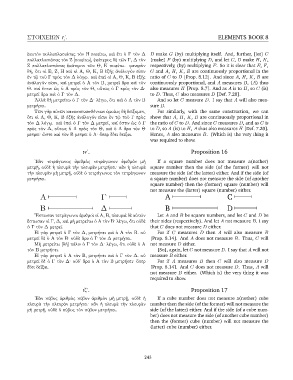
                  Α                        Γ                        .  A                        C

                  Β                        ∆                          B                         D
               ῎Εστωσαν τετρὰγωνοι ἀριθμοὶ οἱ Α, Β, πλευραὶ δὲ αὐτῶν  Let A and B be square numbers, and let C and D be
            ἔστωσαν οἱ Γ, Δ, καὶ μὴ μετρείτω ὁ Α τὸν Β· λὲγω, ὅτι οὐδὲ their sides (respectively). And let A not measure B. I say
            ὁ Γ τὸν Δ μετρεῖ.                                   that C does not measure D either.
               Εἰ γὰρ μετρεῖ ὁ Γ τὸν Δ, μετρήσει καὶ ὁ Α τὸν Β. οὐ  For if C measures D then A will also measure B
                                    izþ
            μετρεῖ δὲ ὁ Α τὸν Β· οὐδὲ ἄρα ὁ Γ τὸν Δ μετρήσει.   [Prop. 8.14]. And A does not measure B. Thus, C will
               Μὴ μετρείτω [δὴ] πάλιν ὁ Γ τὸν Δ· λέγω, ὅτι οὐδὲ ὁ Α not measure D either.
            τὸν Β μετρήσει.                                        [So], again, let C not measure D. I say that A will not
               Εἰ γὰρ μετρεῖ ὁ Α τὸν Β, μετρήσει καὶ ὁ Γ τὸν Δ. οὐ measure B either.
            μετρεῖ δὲ ὁ Γ τὸν Δ· οὐδ᾿ ἄρα ὁ Α τὸν Β μετρήσει· ὅπερ  For if A measures B then C will also measure D
            ἔδει δεῖξαι.                                        [Prop. 8.14]. And C does not measure D. Thus, A will
                                                                not measure B either. (Which is) the very thing it was
                                                                required to show.

                                                                                 Proposition 17
                                      .
               ᾿Εὰν κύβος ἀριθμὸς κύβον ἀριθμὸν μὴ μετρῇ, οὐδὲ ἡ   If a cube number does not measure a(nother) cube
            πλευρὰ τὴν πλευρὰν μετρήσει· κἂν ἡ πλευρὰ τὴν πλευρὰν number then the side (of the former) will not measure the
            μὴ μετρῇ, οὐδὲ ὁ κύβος τὸν κύβον μετρήσει.          side (of the latter) either. And if the side (of a cube num-
                                                                ber) does not measure the side (of another cube number)
                                                                then the (former) cube (number) will not measure the
                                                                (latter) cube (number) either.


                                                             243

