


Page 278 - Euclid's Elements of Geometry
P. 278
ST	EW      jþ.


                                                                                            ELEMENTS BOOK 9


            ποιῇ τινα, ὁ γενόμενος τέλειος ἔσται.               the sum multiplied into the last (number) makes some
               ᾿Απὸ γὰρ μονάδος ἐκκείσθωσαν ὁσοιδηποτοῦν ἀριθμ- (number), then the (number so) created will be perfect.
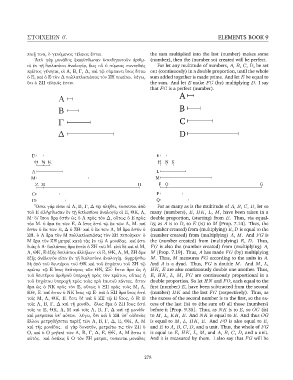
            οὶ ἐν τῇ διπλασίονι ἀναλογίᾳ, ἕως οὗ ὁ σύμπας συντεθεὶς  For let any multitude of numbers, A, B, C, D, be set
            πρῶτος γένηται, οἱ Α, Β, Γ, Δ, καὶ τῷ σύμπαντι ἴσος ἔστω out (continuouly) in a double proportion, until the whole
            ὁ Ε, καὶ ὁ Ε τὸν Δ πολλαπλασιάσας τὸν ΖΗ ποιείτω. λέγω, sum added together is made prime. And let E be equal to
            ὅτι ὁ ΖΗ τέλειός ἐστιν.                             the sum. And let E make FG (by) multiplying D. I say
                                                                that FG is a perfect (number).
                                                                            A
                         Α

                         Β                                                  B

                         Γ                                                  C

                         ∆                                                  D


              Ε                                                   E
               Θ  Ν Κ                                              H  N K
              Λ                                                   L
              Μ                                                   M
                Ζ  Ξ                                       Η       F O                                        G
              Ο                                                   P
              Π                                                   Q
               ῞Οσοι γάρ εἰσιν οἱ Α, Β, Γ, Δ τῷ πλήθει, τοσοῦτοι ἀπὸ  For as many as is the multitude of A, B, C, D, let so
            τοῦ Ε εἰλήφθωσαν ἐν τῇ διπλασίονι ἀναλογίᾳ οἱ Ε, ΘΚ, Λ, many (numbers), E, HK, L, M, have been taken in a
            Μ· δι᾿ ἴσου ἄρα ἐστὶν ὡς ὁ Α πρὸς τὸν Δ, οὕτως ὁ Ε πρὸς  double proportion, (starting) from E. Thus, via equal-
            τὸν Μ. ὁ ἄρα ἐκ τῶν Ε, Δ ἴσος ἐστὶ τῷ ἐκ τῶν Α, Μ. καί ity, as A is to D, so E (is) to M [Prop. 7.14]. Thus, the
            ἐστιν ὁ ἐκ τῶν Ε, Δ ὁ ΖΗ· καὶ ὁ ἐκ τῶν Α, Μ ἄρα ἐστὶν ὁ  (number created) from (multiplying) E, D is equal to the
            ΖΗ. ὁ Α ἄρα τὸν Μ πολλαπλασιάσας τὸν ΖΗ πεποίηκεν· ὁ  (number created) from (multiplying) A, M. And FG is
            Μ ἄρα τὸν ΖΗ μετρεῖ κατὰ τὰς ἐν τῷ Α μονάδας. καί ἐστι  the (number created) from (multiplying) E, D. Thus,
            δυὰς ὁ Α· διπλάσιος ἄρα ἐστὶν ὁ ΖΗ τοῦ Μ. εἰσὶ δὲ καὶ οἱ Μ, FG is also the (number created) from (multiplying) A,
            Λ, ΘΚ, Ε ἑξῆς διπλάσιοι ἀλλήλων· οἱ Ε, ΘΚ, Λ, Μ, ΖΗ ἄρα M [Prop. 7.19]. Thus, A has made FG (by) multiplying
            ἑξῆς ἀνάλογόν εἰσιν ἐν τῇ διπλασίονι ἀναλογίᾳ. ἀφῃρήσθω M. Thus, M measures FG according to the units in A.
            δὴ ἀπὸ τοῦ δευτέρου τοῦ ΘΚ καὶ τοῦ ἐσχάτου τοῦ ΖΗ τῷ And A is a dyad. Thus, FG is double M. And M, L,
            πρώτῳ τῷ Ε ἴσος ἑκάτερος τῶν ΘΝ, ΖΞ· ἔστιν ἄρα ὡς ἡ  HK, E are also continuously double one another. Thus,
            τοῦ δευτέρου ἀριθμοῦ ὑπεροχὴ πρὸς τὸν πρῶτον, οὕτως ἡ  E, HK, L, M, FG are continuously proportional in a
            τοῦ ἐσχάτου ὑπεροχὴ πρὸς τοὺς πρὸ ἑαυτοῦ πάντας. ἔστιν double proportion. So let HN and FO, each equal to the
            ἄρα ὡς ὁ ΝΚ πρὸς τὸν Ε, οὕτως ὁ ΞΗ πρὸς τοὺς Μ, Λ, first (number) E, have been subtracted from the second
            ΚΘ, Ε. καί ἐστιν ὁ ΝΚ ἴσος τῷ Ε· καὶ ὁ ΞΗ ἄρα ἴσος ἐστὶ  (number) HK and the last FG (respectively). Thus, as
            τοῖς Μ, Λ, ΘΚ, Ε. ἔστι δὲ καὶ ὁ ΖΞ τῷ Ε ἴσος, ὁ δὲ Ε  the excess of the second number is to the first, so the ex-
            τοῖς Α, Β, Γ, Δ καὶ τῇ μονάδι. ὅλος ἄρα ὁ ΖΗ ἴσος ἐστὶ  cess of the last (is) to (the sum of) all those (numbers)
            τοῖς τε Ε, ΘΚ, Λ, Μ καὶ τοῖς Α, Β, Γ, Δ καὶ τῇ μονάδι· before it [Prop. 9.35]. Thus, as NK is to E, so OG (is)
            καὶ μετρεῖται ὑπ᾿ αὐτῶν. λέγω, ὅτι καὶ ὁ ΖΗ ὐπ᾿ οὐδενὸς to M, L, KH, E. And NK is equal to E. And thus OG
            ἄλλου μετρηθήσεται παρὲξ τῶν Α, Β, Γ, Δ, Ε, ΘΚ, Λ, Μ is equal to M, L, HK, E. And FO is also equal to E,
            καὶ τῆς μονάδος. εἰ γὰρ δυνατόν, μετρείτω τις τὸν ΖΗ ὁ  and E to A, B, C, D, and a unit. Thus, the whole of FG
            Ο, καὶ ὁ Ο μηδενὶ τῶν Α, Β, Γ, Δ, Ε, ΘΚ, Λ, Μ ἔστω ὁ  is equal to E, HK, L, M, and A, B, C, D, and a unit.
            αὐτός. καὶ ὁσάκις ὁ Ο τὸν ΖΗ μετρεῖ, τοσαῦται μονάδες  And it is measured by them. I also say that FG will be


                                                             278

