


Page 277 - Euclid's Elements of Geometry
P. 277
ST	EW      jþ.     leþ                                                      ELEMENTS BOOK 9


                                      .
                                                                                                †
                                                                                Proposition 35
               ᾿Εὰν ὦσιν ὁσοιδηποτοῦν ἀριθμοὶ ἑξῆς ἀνάλογον, ἀφαι-  the very thing it was required to show.
                                                                   If there is any multitude whatsoever of continually
            ρεθῶσι δὲ ἀπό τε τοῦ δευτέρου καὶ τοῦ ἐσχάτου ἴσοι τῷ proportional numbers, and (numbers) equal to the first
            πρώτῳ, ἔσται ὡς ἡ τοῦ δευτέρου ὑπεροχὴ πρὸς τὸν πρῶτον, are subtracted from (both) the second and the last, then
            οὕτως ἡ τοῦ ἐσχάτου ὑπεροχὴ πρὸς τοὺς πρὸ ἑαυτοῦ as the excess of the second (number is) to the first, so the
            πάντας.                                             excess of the last will be to (the sum of) all those (num-
                                                                bers) before it.
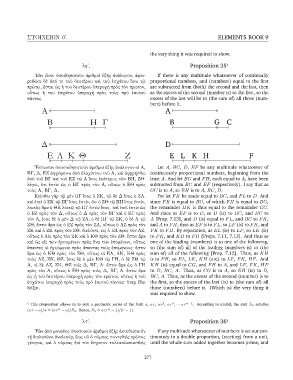
                  Α                                                   A

                     Β                 Η    Γ                           B                  G    C


                  ∆                                                   D

                     Ε   Λ Κ      Θ                  Ζ                  E    L K      H                  F

               ῎Εστωσαν ὁποσοιδηποτοῦν ἀριθμοὶ ἑξῆς ἀνάλογον οἱ Α,  Let A, BC, D, EF be any multitude whatsoever of
            ΒΓ, Δ, ΕΖ ἀφχόμενοι ἀπὸ ἐλαχίστου τοῦ Α, καὶ ἀφῃρήσθω continuously proportional numbers, beginning from the
            ἀπὸ τοῦ ΒΓ καὶ τοῦ ΕΖ τῲ Α ἴσος ἑκάτερος τῶν ΒΗ, ΖΘ· least A. And let BG and FH, each equal to A, have been
            λέγω, ὅτι ἐστὶν ὡς ὁ ΗΓ πρὸς τὸν Α, οὕτως ὁ ΕΘ πρὸς  subtracted from BC and EF (respectively). I say that as
            τοὺς Α, ΒΓ, Δ.                                      GC is to A, so EH is to A, BC, D.
               Κείσθω γὰρ τῷ μὲν ΒΓ ἴσος ὁ ΖΚ, τῷ δὲ Δ ἴσος ὁ ΖΛ.  For let FK be made equal to BC, and FL to D. And
            καὶ ἐπεὶ ὁ ΖΚ τῷ ΒΓ ἴσος ἐστίν, ὧν ὁ ΖΘ τῷ ΒΗ ἴσος ἐστίν, since FK is equal to BC, of which FH is equal to BG,
            λοιπὸς ἄρα ὁ ΘΚ λοιπῷ τῷ ΗΓ ἐστιν ἴσος. καὶ ἐπεί ἐστιν ὡς  the remainder HK is thus equal to the remainder GC.
            ὁ ΕΖ πρὸς τὸν Δ, οὕτως ὁ Δ πρὸς τὸν ΒΓ καὶ ὁ ΒΓ πρὸς  And since as EF is to D, so D (is) to BC, and BC to
            τὸν Α, ἴσος δὲ ὁ μὲν Δ τῷ ΖΛ, ὁ δὲ ΒΓ τῷ ΖΚ, ὁ δὲ Α τῷ A [Prop. 7.13], and D (is) equal to FL, and BC to FK,
            ΖΘ, ἔστιν ἄρα ὡς ὁ ΕΖ πρὸς τὸν ΖΛ, οὕτως ὁ ΛΖ πρὸς τὸν and A to FH, thus as EF is to FL, so LF (is) to FK, and
            ΖΚ καὶ ὁ ΖΚ πρὸς τὸν ΖΘ. διελόντι, ὡς ὁ ΕΛ πρὸς τὸν ΛΖ, FK to FH. By separation, as EL (is) to LF, so LK (is)
            οὕτως ὁ ΛΚ πρὸς τὸν ΖΚ καὶ ὁ ΚΘ πρὸς τὸν ΖΘ. ἔστιν ἄρα to FK, and KH to FH [Props. 7.11, 7.13]. And thus as
            καὶ ὡς εἷς τῶν ἡγουμένων πρὸς ἕνα τῶν ἑπομένων, οὕτως one of the leading (numbers) is to one of the following,
            ἅπαντες οἱ ἡγούμενοι πρὸς ἅπαντας τοὺς ἑπομένους· ἔστιν so (the sum of) all of the leading (numbers is) to (the
            ἄρα ὡς ὁ ΚΘ πρὸς τὸν ΖΘ, οὕτως οἱ ΕΛ, ΛΚ, ΚΘ πρὸς   sum of) all of the following [Prop. 7.12]. Thus, as KH
            τοὺς ΛΖ, ΖΚ, ΘΖ. ἴσος δὲ ὁ μὲν ΚΘ τῷ ΓΗ, ὁ δὲ ΖΘ τῷ is to FH, so EL, LK, KH (are) to LF, FK, HF. And
            Α, οἱ δὲ ΛΖ, ΖΚ, ΘΖ τοὶς Δ, ΒΓ, Α· ἔστιν ἄρα ὡς ὁ ΓΗ KH (is) equal to CG, and FH to A, and LF, FK, HF
                                   lþ                          was required to show.
            πρὸς τὸν Α, οὕτως ὁ ΕΘ πρὸς τοὺς Δ, ΒΓ, Α. ἔστιν ἄρα to D, BC, A. Thus, as CG is to A, so EH (is) to D,
            ὡς ἡ τοῦ δευτέρου ὑπεροχὴ πρὸς τὸν πρῶτον, οὕτως ἡ τοῦ BC, A. Thus, as the excess of the second (number) is to
            ἐσχάτου ὑπεροχὴ πρὸς τοὺς πρὸ ἑαυτοῦ πάντας· ὅπερ ἔδει the first, so the excess of the last (is) to (the sum of) all
            δεῖξαι.                                             those (numbers) before it. (Which is) the very thing it


            †  This proposition allows us to sum a geometric series of the form a, a r, a r , a r , · · · a r n−1 . According to Euclid, the sum S n satisfies
                                                                         3
                                                                     2
                                              n
                         n
            (a r − a)/a = (a r − a)/S n. Hence, S n = a (r − 1)/(r − 1).                        †
                                                                                Proposition 36
                                      .
               ᾿Εὰν ἀπὸ μονάδος ὁποσοιοῦν ἀριθμοὶ ἑξῆς ἐκτεθῶσιν ἐν  If any multitude whatsoever of numbers is set out con-
            τῇ διπλασίονι ἀναλογίᾳ, ἕως οὗ ὁ σύμπας συντεθεὶς πρῶτος  tinuously in a double proportion, (starting) from a unit,
            γένηται, καὶ ὁ σύμπας ἐπὶ τὸν ἔσχατον πολλαπλασιασθεὶς until the whole sum added together becomes prime, and

                                                             277

