


Page 132 - Jolliffe I. Principal Component Analysis
P. 132
5.3. Biplots
                                                                                            101


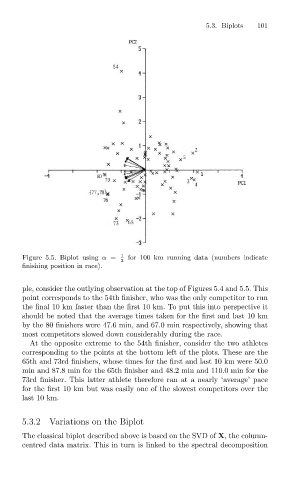
                              Figure 5.5. Biplot using α =  1  for 100 km running data (numbers indicate
                                                        2
                              finishing position in race).

                              ple, consider the outlying observation at the top of Figures 5.4 and 5.5. This
                              point corresponds to the 54th finisher, who was the only competitor to run
                              the final 10 km faster than the first 10 km. To put this into perspective it
                              should be noted that the average times taken for the first and last 10 km
                              by the 80 finishers were 47.6 min, and 67.0 min respectively, showing that
                              most competitors slowed down considerably during the race.
                                At the opposite extreme to the 54th finisher, consider the two athletes
                              corresponding to the points at the bottom left of the plots. These are the
                              65th and 73rd finishers, whose times for the first and last 10 km were 50.0
                              min and 87.8 min for the 65th finisher and 48.2 min and 110.0 min for the
                              73rd finisher. This latter athlete therefore ran at a nearly ‘average’ pace
                              for the first 10 km but was easily one of the slowest competitors over the
                              last 10 km.

                              5.3.2 Variations on the Biplot

                              The classical biplot described above is based on the SVD of X, the column-
                              centred data matrix. This in turn is linked to the spectral decomposition

