


Page 136 - Jolliffe I. Principal Component Analysis
P. 136
5.4. Correspondence Analysis
                                                                                            105


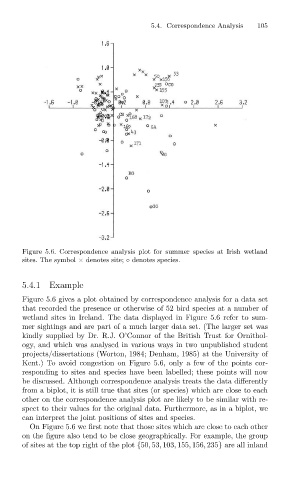
                              Figure 5.6. Correspondence analysis plot for summer species at Irish wetland
                              sites. The symbol × denotes site; ◦ denotes species.


                              5.4.1 Example
                              Figure 5.6 gives a plot obtained by correspondence analysis for a data set
                              that recorded the presence or otherwise of 52 bird species at a number of
                              wetland sites in Ireland. The data displayed in Figure 5.6 refer to sum-
                              mer sightings and are part of a much larger data set. (The larger set was
                              kindly supplied by Dr. R.J. O’Connor of the British Trust for Ornithol-
                              ogy, and which was analysed in various ways in two unpublished student
                              projects/dissertations (Worton, 1984; Denham, 1985) at the University of
                              Kent.) To avoid congestion on Figure 5.6, only a few of the points cor-
                              responding to sites and species have been labelled; these points will now
                              be discussed. Although correspondence analysis treats the data differently
                              from a biplot, it is still true that sites (or species) which are close to each
                              other on the correspondence analysis plot are likely to be similar with re-
                              spect to their values for the original data. Furthermore, as in a biplot, we
                              can interpret the joint positions of sites and species.
                                On Figure 5.6 we first note that those sites which are close to each other
                              on the figure also tend to be close geographically. For example, the group
                              of sites at the top right of the plot {50, 53, 103, 155, 156, 235} are all inland

