


Page 156 - Jolliffe I. Principal Component Analysis
P. 156
125
                                                        6.1. How Many Principal Components?
                              needs to be estimated; an obvious estimate is the average of the (p − q)
                              smallest eigenvalues of S.
                                Besse and de Falguerolles (1993) start from the same fixed effects model
                              and concentrate on the special case just noted. They modify the loss
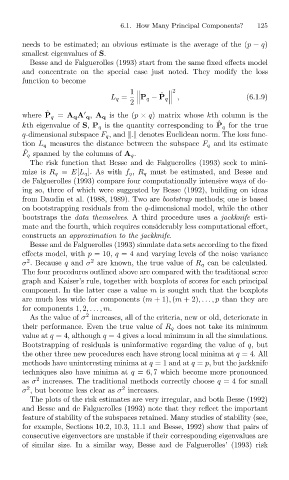
                              function to become
                                                                     2

                                                     L q =  1     ˆ                      (6.1.9)
                                                             P q − P q  ,
                                                          2
                                    ˆ
                              where P q = A q A q , A q is the (p × q) matrix whose kth column is the

                                                                                 ˆ
                              kth eigenvalue of S, P q is the quantity corresponding to P q for the true
                              q-dimensional subspace F q ,and  .  denotes Euclidean norm. The loss func-
                              tion L q measures the distance between the subspace F q and its estimate
                              ˆ
                              F q spanned by the columns of A q .
                                The risk function that Besse and de Falguerolles (1993) seek to mini-
                              mize is R q = E[L q ]. As with f q , R q must be estimated, and Besse and
                              de Falguerolles (1993) compare four computationally intensive ways of do-
                              ing so, three of which were suggested by Besse (1992), building on ideas
                              from Daudin et al. (1988, 1989). Two are bootstrap methods; one is based
                              on bootstrapping residuals from the q-dimensional model, while the other
                              bootstraps the data themselves. A third procedure uses a jackknife esti-
                              mate and the fourth, which requires considerably less computational effort,
                              constructs an approximation to the jackknife.
                                Besse and de Falguerolles (1993) simulate data sets according to the fixed
                              effects model, with p = 10, q = 4 and varying levels of the noise variance
                               2
                                                2
                              σ . Because q and σ are known, the true value of R q can be calculated.
                              The four procedures outlined above are compared with the traditional scree
                              graph and Kaiser’s rule, together with boxplots of scores for each principal
                              component. In the latter case a value m is sought such that the boxplots
                              are much less wide for components (m +1), (m +2),...,p than they are
                              for components 1, 2,... ,m.
                                              2
                                As the value of σ increases, all of the criteria, new or old, deteriorate in
                              their performance. Even the true value of R q does not take its minimum
                              value at q = 4, although q = 4 gives a local minimum in all the simulations.
                              Bootstrapping of residuals is uninformative regarding the value of q, but
                              the other three new procedures each have strong local minima at q =4.All
                              methods have uninteresting minima at q =1 and at q = p, but the jackknife
                              techniques also have minima at q =6, 7 which become more pronounced
                                 2
                              as σ increases. The traditional methods correctly choose q = 4 for small
                                                        2
                               2
                              σ , but become less clear as σ increases.
                                The plots of the risk estimates are very irregular, and both Besse (1992)
                              and Besse and de Falguerolles (1993) note that they reflect the important
                              feature of stability of the subspaces retained. Many studies of stability (see,
                              for example, Sections 10.2, 10.3, 11.1 and Besse, 1992) show that pairs of
                              consecutive eigenvectors are unstable if their corresponding eigenvalues are
                              of similar size. In a similar way, Besse and de Falguerolles’ (1993) risk

