


Page 5 - Russias_Quiet_Military_Revolution_Neat
P. 5
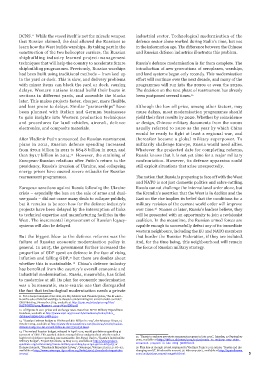
DCNS.11 While the vessel itself is not the miracle weapon                                  industrial sector. Technological modernisation of the
that Russian claimed, the deal allowed the Russians to                                     defence sector alone worked during Stalin’s time, but not
learn how the West builds warships. By taking part in the                                  in the information age. The difference between the Chinese
construction of the two helicopter carriers, the Russian                                   and Russian defence industries illustrates this problem.
shipbuilding industry learned project-management
techniques that will help the country to accelerate future                                 Russia’s defence modernisation is far from complete. The
shipbuilding programmes. Previously, Russian warships                                      introduction of new generations of aeroplanes, warships,
had been built using traditional methods – from keel up                                    and land systems began only recently. This modernisation
in the yard or dock. This is slow, and delivery problems                                   effort will continue over the next decade, and many of the
with minor items can block the yard or dock, causing                                       programmes will run into the 2020s or even the 2030s.
delays. Western nations instead build their boats in                                       The decision on the next phase of rearmament has already
sections in different yards, and assemble the blocks                                       been postponed several times.15
later. This makes projects faster, cheaper, more flexible,
and less prone to delays. Similar “partnerships” have                                      Although the low oil price, among other factors, may
been planned with Italian and German businesses                                            cause delays, most modernisation programmes should
to gain insights into Western production techniques                                        yield their first results by 2020. Whether by coincidence
and procedures for land vehicles, aircraft, defence                                        or design, Chinese military documents from the 2000s
electronics, and composite materials.                                                      usually referred to 2020 as the year by which China
                                                                                           would be ready to fight at least a regional war, and
After Vladimir Putin announced the Russian rearmament                                      thereafter become a global military superpower. To
plans in 2012, Russian defence spending increased                                          militarily challenge Europe, Russia would need allies.
from $70.2 billion in 2011 to $84.8 billion in 2013, and                                   Whatever the projected date for completing reforms,
then $91.7 billion in 2014.12 However, the straining of                                    Russia knows that it is not yet time for a major military
European-Russian relations after Putin’s return to the                                     confrontation. However, its defence apparatus could
presidency, Russia’s invasion of Ukraine, and collapsing                                   still exploit situations that arise unexpectedly.
energy prices have caused severe setbacks for Russian
rearmament programmes.                                                                     The notion that Russia is preparing to face off with the West
                                                                                           and NATO is not just domestic politics and sabre-rattling.
European sanctions against Russia following the Ukraine                                    Russia cannot challenge the international order alone, but
crisis – especially the ban on the sale of arms and dual-                                  the Kremlin’s assertion that the West is in decline and the
use goods – did not cause many deals to collapse publicly,                                 East on the rise implies its belief that the conditions for a
but it remains to be seen how far the defence industry’s                                   military revision of the current world order will improve
projects have been delayed by the interruption of links                                    over time.16 Sooner or later, Russia’s leaders believe, they
to technical expertise and manufacturing facilities in the                                 will be presented with an opportunity to join a revisionist
West. The incremental improvement of Russian legacy-                                       coalition. In the meantime, the Russian armed forces are
systems will also be delayed.                                                              capable enough to successfully defeat any of its immediate
                                                                                           western neighbours, including the EU and NATO members
But the biggest blow to the defence reforms was the                                        that border the Russian Federation, if they are isolated.
failure of Russian economic modernisation policy in                                        And, for the time being, this neighbourhood will remain
general. In 2015, the government further increased the                                     the focus of Russian military strategy.
proportion of GDP spent on defence in the face of rising
inflation and falling GDP,13 but there are doubts about                                    15 “Russia to endorse new state armament program in late 2015”, Interfax, 27 September       5
whether this is sustainable.14 China’s defence industry                                    2015, available at http://rbth.co.uk/news/2013/09/27/russia_to_endorse_new_state_
has benefited from the country’s overall economic and                                      armament_program_in_late_2015_30208.html.
industrial modernisation. Russia, meanwhile, has failed
to modernise at all. Its plan for economic modernisation                                   16 This line of thought is best explained in Vladimir Putin’s 2012 article, “Russia and the
was a bureaucratic, state-centric one that disregarded                                     changing world”, Moskovskie novosti, 26 February 2012, available at http://sputniknews.
the fact that technological modernisation needs a private                                  com/analysis/20120227/171547818.html.

11 For a deeper analysis of the deal, see Roy Isbister and Yannick Quéau, “An ill wind –
How the sale of Mistral warships to Russia is undermining EU arms transfer controls”,
GRIP Briefing, November 2014, available at http://grip.org/sites/grip.org/files/
RAPPORTS/2014/Rapport_2014-7%20(EN).pdf.

12 All figures in 2011 prices and exchange rates. Data from SIPRI Military Expenditure
Database, available at http://www.sipri.org/research/armaments/milex/milex_
database/milex-data-1988-2014.

13 “Russian Defense Budget to Hit Record $81 Billion in 2015”, the Moscow Times, 16
October 2014, available at http://www.themoscowtimes.com/business/article/russian-
defense-budget-to-hit-record-81bln-in-2015/509536.html.

14 The revised Russian budget, released in April 2015, would put defence spending at
9 percent of GDP. This sparked debate among defence analysts about whether such a
high level of defence spending was sustainable. See Sergei Guriev, “Russia’s Indefensible
Military Budget”, Project Syndicate, 14 May 2015, available at http://www.project-
syndicate.org/commentary/russia-military-spending-by-sergei-guriev-2015-05; or
Hannes Adomeit, “Russlands Imperialer Irrweg”, Osteuropa, Volume 3/2015, p. 67–93,
available at http://www.osteuropa.dgo-online.org/hefte/2015/3/russlands-imperialer-
irrweg/.

