


Page 7 - Russias_Quiet_Military_Revolution_Neat
P. 7
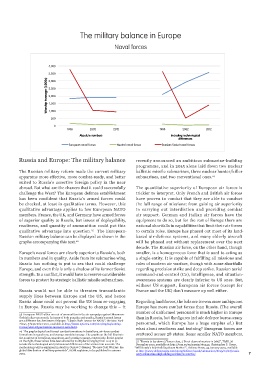
The military balance in Europe

                                                        Naval forces

Warship tonnage (1,000s)  4,000
                          3,500
                          3,000   1988            2002       2012                        1988  2002                     2012
                          2,500         Absolute
  numbers     Neutral naval forces
                          2,000
                          1,500
                          1,000

                            500
                               0

                                                                                               Including technological
                                                                                                      differences

                                  European naval forces                                  Russian/Soviet naval forces

Russia and Europe: The military balance                                                  recently announced an ambitious submarine-building
                                                                                         programme, and in 2015 alone laid down two nuclear
The Russian military reform made the current military                                    ballistic missile submarines, three nuclear hunter/killer
apparatus more effective, more combat-ready, and better                                  submarines, and two conventional ones.27
suited to Russia’s assertive foreign policy in the near
abroad. But what are the chances that it could successfully                              The quantitative superiority of European air forces is
challenge the West? The European defence establishment                                   trickier to interpret. Only French and British air forces
has been confident that Russia’s armed forces could                                      have proven in combat that they are able to conduct
be checked, at least in qualitative terms. However, this                                 the full range of missions: from gaining air superiority
qualitative advantage applies to few European NATO                                       to carrying out interdiction and providing combat
members. France, the UK, and Germany have armed forces                                   air support. German and Italian air forces have the
of superior quality to Russia, but issues of deployability,                              equipment to do so, but for the rest of Europe there are
readiness, and quantity of ammunition could put this                                     national shortfalls in capabilities that limit their air forces
qualitative advantage into question.25 The European-                                     to certain roles. Europe has phased out most of its land-
Russian military balance can be displayed as shown in the                                based air-defence systems, and many elderly aircraft
graphs accompanying this text.26                                                         will be phased out without replacement over the next
                                                                                         decade. The Russian air force, on the other hand, though
Europe’s naval forces are clearly superior to Russia’s, both                             smaller, is a homogeneous force that is used to acting as
in numbers and in quality. Aside from its submarine wing,                                a single entity. It is capable of fulfilling all missions and
Russia has nothing to put to sea that could challenge                                    roles of modern air warfare, though with some shortfalls
Europe, and even this is only a shadow of its former Soviet                              regarding precision strike and deep strike. Russian aerial
strength. In a conflict, it would have to reserve considerable                           command-and-control (C2), intelligence, and situation-
forces to protect its strategic ballistic missile submarines.                            awareness systems are clearly inferior to US ones. But,
                                                                                         without US support, European air forces (except for
Russia would not be able to threaten transatlantic                                       France and the UK) don’t measure up well either.
supply lines between Europe and the US, and hence
Russia alone could not prevent the US from re-engaging                                   Regarding land forces, the balance is even more ambiguous.                           7
in Europe. Russia may be working to change this – it                                     Europe has more combat forces than Russia. (The overall
                                                                                         number of uniformed personnel is much higher in Europe
25 European NATO allies ran out of ammunition in the air campaign against Muammar        than in Russia, but the figures include defence bureaucracy
Gaddafi after one month. In terms of both quantity and quality, Russia’s armed forces     personnel, which Europe has a huge surplus of.) But
are a different foe. See Steven Erlanger, “Libya’s Dark Lesson for NATO”, the New York   what about readiness and training? European forces are
Times, 3 September 2011, available at http://www.nytimes.com/2011/09/04/sunday-           scattered across 28 states. Some smaller NATO members,
review/what-libyas-lessons-mean-for-nato.html.
26 The graphs depict land forces’ combat formations in battalions, air-force combat       27 “Russia to lay down 3 Yasen-class, 2 Borei-class submarine in 2015”, TASS, 26
formations in squadrons, and average warship tonnage. The graphs on the left illustrate   December 2015, available at http://tass.ru/en/russia/769342; Christopher P. Cavas,
the numbers of battalions, squadrons, and warship tonnage, respectively. In the graphs   “Will Russia’s Sub-Building Boom Matter?”, Defense News, 24 January 2015, available
on the right, these values have been altered by multipliers (ranging from 0.25 to 3)      at http://www.defensenews.com/story/defense/naval/submarines/2015/01/24/russia-
to take the technological and professional differences of the armies into account. The    navy-submarine-shipbuilding-nuclear/22190761/.
methodology will be explained in detail in Gustav C. Gressel, “No new Cold War yet: the
global distribution of military potentials”, ECFR explainer, to be published in autumn
2015.

