


Page 3 - PDF
P. 3
IMPACT 3
                   A skilled and educated workforce with instruction that is relevant
                     to the dynamics of the contemporary workplace is essential for
                            building the biotechnology industry locally.

                                 James Greenwood, CEO, Bio


           EMBRACING THE FUTURE


                                                                                       Denise  Schweizer
          A     s many U.S. manufacturing communities work to reinvent themselves, economic   Chemistry Instructor,
                                                                                       BIFP Co-Principal Investigator

                                                                                       Rowan-Cabarrus
                                                                                       Community College
                developers and higher education institutions have made significant investments

                to build or expand their biotechnology industries, often leveraging
         entrepreneurial and university resources. The emphasis on STEM education and skills is
         prominent at all levels.
         Workforce research tells us that success depends on two factors: increasing the number
         of STEM students that pursue bioscience careers and continually improving STEM
         education to effectively develop career-ready graduates. STEM instructors in colleges
         and high schools are uniquely positioned to impact both factors.

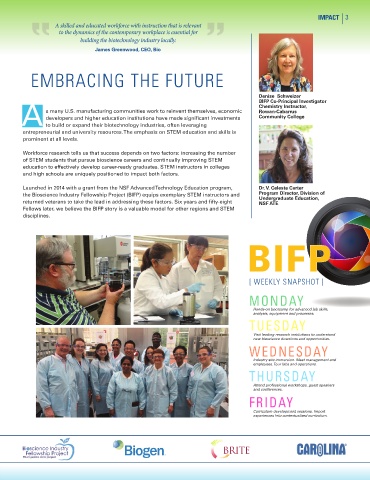
         Launched in 2014 with a grant from the NSF Advanced Technology Education program,  Dr. V. Celeste Carter
         the Bioscience Industry Fellowship Project (BIFP) equips exemplary STEM instructors and   Program Director, Division of
                                                                                       Undergraduate Education,
         returned veterans to take the lead in addressing these factors. Six years and fifty-eight   NSF ATE
         Fellows later, we believe the BIFP story is a valuable model for other regions and STEM
         disciplines.


                                                                                   BIFP


                                                                                    [ WEEKLY SNAPSHOT ]

                                                                                   MONDAY

                                                                                     Hands-on bootcamp for advanced lab skills,
                                                                                     analysis, equipment and processes.
                                                                                   TUESDAY

                                                                                     Visit leading research institutions to understand
                                                                                     new bioscience directions and opportunities.
                                                                                   WEDNESDAY

                                                                                     Industry site immersion. Meet management and
                                                                                     employees. Tour labs and operations.
                                                                                   THURSDAY

                                                                                     Attend professional workshops, guest speakers
                                                                                     and conferences.
                                                                                   FRIDAY

                                                                                     Curriculum development sessions. Import
                                                                                     experiences into contextualized curriculum.

