


Page 37 - SOA 109
P. 37
HighunDry


         for a squelchy bare foot walk. It became clear that walking in deck boots
         was harder than bare foot and the blisters I suffered from the previous day
         were soothed. Food was rationed, toilet visits and use of electrics also. Un-
         able to run the engine, we had no means of topping up the batteries. We
         used Humber water to flush the heads. The flush water I collected from a
         pool at the stern which had been created by the
         churning of the prop. The water was poured into
         empty 5 litre water bottles, which were left over-
         night  to  allow  the  mud  sediment  to  settle  out.
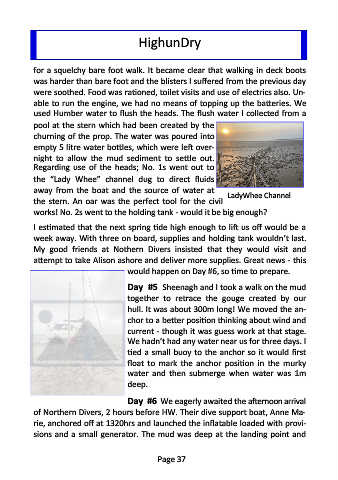
         Regarding use of the heads; No. 1s went out to
         the  “Lady  Whee”  channel  dug  to  direct  fluids
         away from the boat and  the source of water at
                                                         LadyWhee Channel
         the stern. An oar was the perfect tool for the civil
         works! No. 2s went to the holding tank - would it be big enough?
         I estimated that the next spring tide high enough to lift us off would be a
         week away. With three on board, supplies and holding tank wouldn’t last.
         My  good  friends  at  Nothern  Divers  insisted  that  they  would  visit  and
         attempt to take Alison ashore and deliver more supplies. Great news - this
                                would happen on Day #6, so time to prepare.

                                Day  #5  Sheenagh and I took a walk on the mud
                                together  to  retrace  the  gouge  created  by  our
                                hull. It was about 300m long! We moved the an-
                                chor to a better position thinking about wind and
                                current - though it was guess work at that stage.
                                We hadn’t had any water near us for three days. I
                                tied a small buoy to the anchor so it would first
                                float  to  mark  the  anchor  position  in  the  murky
                                water  and  then  submerge  when  water  was  1m
                                deep.

                                Day  #6  We eagerly awaited the afternoon arrival
         of Northern Divers, 2 hours before HW. Their dive support boat, Anne Ma-
         rie, anchored off at 1320hrs and launched the inflatable loaded with provi-
         sions and a small generator. The mud was deep at the landing point and

                                        Page 37

