


Page 27 - SOA 108
P. 27
Atlantic Crossing


         Among  the  200  or  so  boats  participating  this  year,  11  were  flying  the
         French  flag,  but  there  were  also  some  French  crew  members  on  other
         boats. Among the French, were Régis Guillemot on a fast catamaran (they
         almost sank before arriving at La Palmas, but had made a temporary repair
         for the Atlantic crossing) and Jean-Pierre Dick on a 60 feet yacht. These
         guys were obviously not there to do cruising.

         A busy week, which ended with the satisfaction of feeling ready!  We were
         quietly waiting for  the start, while our pontoon neighbors, Brits on one
         side, Swedish on the other, were briefing and debriefing: this would be a
         race, and it was taken very seriously!
         2- Crossing  the Atlantic


         The departure was planned at 12:30 pm on
         Sunday  November  24  for  the  category     With our Southerly
         "cruising", in which we were registered. Chris  35RS, the third smallest
         Tibbs,  the  ARC  weather  expert,  had  told  us   boat at the start,
         the weather situation would be complex, and
         not  very  favorable  for  the  departure,  with  the  risk  of  very  low  winds,
         sometimes  headwind,  on  the  direct  route.  He  had  advised  the  heaviest
         boats to go South to find more established trade winds. He also advised us
         to beware of strong and turbulent winds in close, South of the Canaries.
         Before the departure, I made an estimate of our ETA with my Seamanpro
         software:  we  were  to  arrive  Friday  December  20th  at  6:00  UTC,  which
         meant the last day, 10 hours before the closing of the finish line.  With a
                                            curved  road  to  the  South,  about
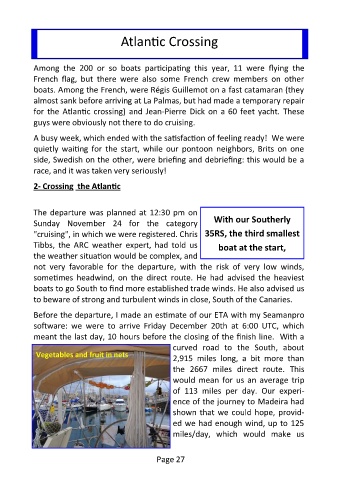
          Vegetables and fruit in nets
                                            2,915  miles  long,  a  bit  more  than
                                            the  2667  miles  direct  route.  This
                                            would mean for us an average trip
                                            of  113  miles  per  day.  Our  experi-
                                            ence of the journey to Madeira had
                                            shown that we could hope, provid-
                                            ed we had enough wind, up to 125
                                            miles/day,  which  would  make  us


                                        Page 27

