


Page 200 - ...........
P. 200
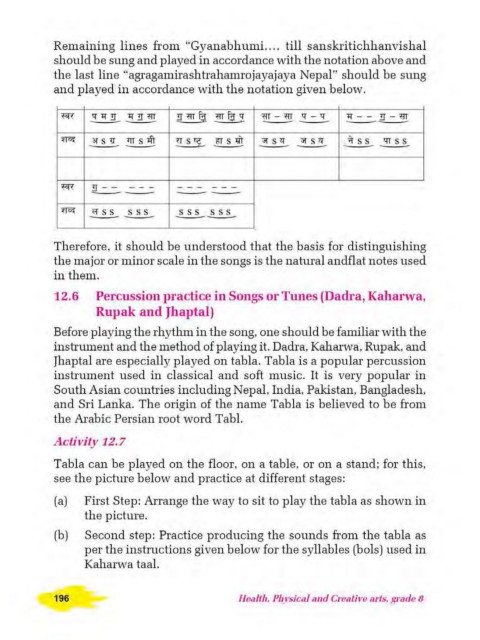
Remaining lines from  "Gyanabhumi. ...  till sanskritichhanvishal
            should be sung and played in accordance with the notation above and
            the last line "agragamirashtrahamrojayajaya Nepal" should be sung
            and played in accordance with the notation given below.

                    --                         ___,__.....   -   -         --
              ~  q  +:r  !r  +:r  !rm   ~                m-m  -cr--cr      +:r  - - !r - m
                                               m ftr -er
                    -       -                           -       -         -       -
              ~  3f s lJ  Tff  s +fr   ~ ~                       \jj"  s <r   ~ s s   qr s s
                                                         ~ s <r


                    -- ------
              ~  :rr- -     ---        - - - - - -
                    -- ------
              "l!TCG   ~ s s  s s s    s s s  SSS


            Therefore, it should be understood that the basis for distinguishing
            the major or minor scale in the songs is the natural andflat notes used
            in them.

            12.6     Percussion practice in Songs or Tunes (Dadra, Kaharwa,
                     Rupak and Jhaptal)
            Before playing the rhythm in the song, one should be familiar with the
            instrument and the method of playing it. Dadra, Kaharwa, Rupak, and
            Jhaptal are especially played on tabla. Tabla is a popular percussion
            instrument used in classical  and soft m.usic.  It is  very popular in
            South Asian countries including Nepal, India, Pakistan, Bangladesh,
            and Sri Lanka. The origin of the name Tabla is believed to be from
            the Arabic Persian root word Tabl.

            Activity  12.7

            Tabla can be played on the floor,  on a table,  or on a stand; for this,
            see the pictw·e below and practice at different stages:

            (a)    First Step: Arrange the way to sit to play the tabla as shown in
                   the picture.
            (b)    Second step: Practice producing the sounds from the tabla as
                   per the instructions given below for the syllables (bols) used in
                   Kaharwa taal.

