


Page 205 - ...........
P. 205
12. 7    Introduction and Practice of Rhythn1 (Jhyaure, Khyali,
                     Samhala, and Selo)
            The  relation  between  Sur and  Taal  (melody  and  rhythm)  is
            indispensable. They are incomplete without each other. Melody, tunes
            played on.a musical instrument, singing, and dance are all guided by
            the rhythm. Therefore, rhythm has a vital role in music. The nlethod
            or  medium of measuringthe time  used in singing and playing is
            known as Taal.A Taal is a composition made by combining different
            bols or syllables coming out of a musical instrument having a certain
            number of beats, division, Tali, and Khali. Different names and types
            of Taals are created based on beats, division, and syllables. Jhyaure,
            Khyali, Samhala, Selo, Kaharwa, Dadra, Rupak, Jhaptal, Tin Tal, etc.
            have been used in music. In this lesson, we will study some of these
            rhythms that are popular in inusic, and we will also practice playing
            them in different stages.

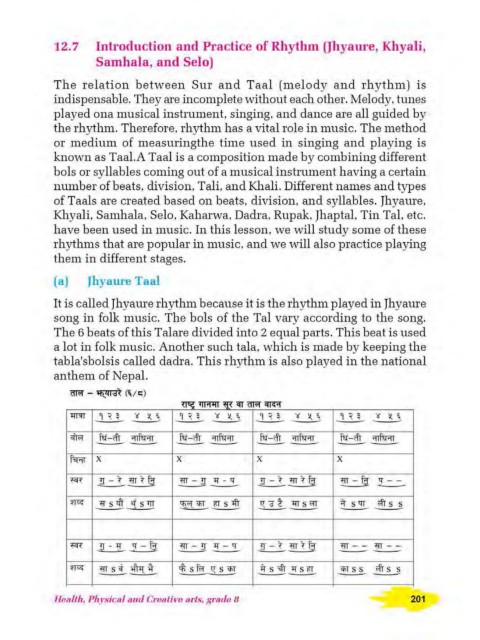
            (a)    Jhyaure Taal

            It is called Jhyaure rhyth111 because it is the rhyth111 played in Jhyaure
            song in folk music. The bols of the Tal vary according to the song.
            The 6 beats of this Talare divided into 2 equal parts. This beat is used
            a lot in folk music. Another such tala, which is made by keeping the
            tabla'sbolsis called dadra. This rhythm is also played in the national
            anthem of Nepal.

                ~ - ~ (Ve;)
                                       ~TfAlrr~Cl'T~~
                             -  "'\   -1.3.j_   -  "' \   -1.3.j_   -  "' \   -1..U..- ~
                     -1..U..-
                l1T'fr        ¥                ¥                ¥
                     --                                -- --
                ~  fu' -<fr  'flftRT   ~ 'flftRT        fu'-<fr   ~  fu'-<fr  'flftRT
                ~  x                  x                 x                x


                t<IT   !I - t  m t f'ir   m - !I  ir - tf   !I - t  ~  m - f'ir   -----
                                                                                  tf - -
                      -----=           - ·-                              --=
                ~ 'ij"sm  ~s<rr        ~ <PT  ITT  s lfr   ti; \3" ~  msm   ~ s qr  <fr s  s
                     -~ ~-                              ~-               --

                                      --
                                                                         m - - m - -
                t<IT   ~~                               1L=-l-~          --
                                       m - !I  lf - tf
                      m s <f  ..fnt. *
                ~TGG                   ~S~ 'C!;S<PT     ~sm~  ~ <frs  s

            Tlo11/Lh, Physicnl and Crrmlivo 11rl.'>,  grnrln 0                          201

