


Page 310 - PGM Compendium
P. 310
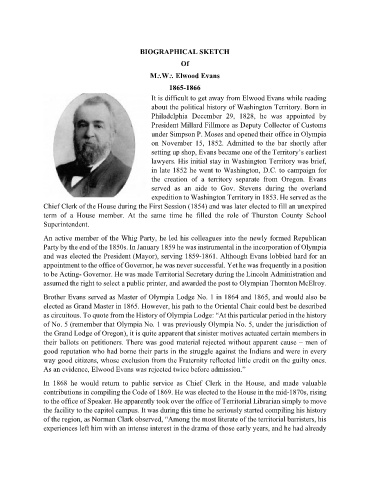
BIOGRAPHICAL SKETCH
                                                             Of
                                                   M⸫W⸫ Elwood Evans

                                                         1865-1866
                                                   It is difficult to get away from Elwood Evans while reading
                                                   about the political history of Washington Territory. Born in
                                                   Philadelphia December 29, 1828, he was appointed by
                                                   President Millard Fillmore as Deputy Collector of Customs
                                                   under Simpson P. Moses and opened their office in Olympia
                                                   on November 15, 1852. Admitted to the bar shortly after
                                                   setting up shop, Evans became one of the Territory’s earliest
                                                   lawyers. His initial stay in Washington Territory was brief,
                                                   in late 1852 he went to Washington, D.C. to campaign for
                                                   the creation of a territory separate from Oregon.  Evans
                                                   served as an aide to Gov. Stevens during the overland
                                                   expedition to Washington Territory in 1853. He served as the
               Chief Clerk of the House during the First Session (1854) and was later elected to fill an unexpired
               term of a House member. At the same time he filled the role of Thurston County  School
               Superintendent.

               An active member of the Whig Party, he led his colleagues into the newly formed Republican
               Party by the end of the 1850s. In January 1859 he was instrumental in the incorporation of Olympia
               and was elected the President (Mayor), serving 1859-1861. Although Evans lobbied hard for an
               appointment to the office of Governor, he was never successful. Yet he was frequently in a position
               to be Acting- Governor. He was made Territorial Secretary during the Lincoln Administration and
               assumed the right to select a public printer, and awarded the post to Olympian Thornton McElroy.

               Brother Evans served as Master of Olympia Lodge No. 1 in 1864 and 1865, and would also be
               elected as Grand Master in 1865. However, his path to the Oriental Chair could best be described
               as circuitous. To quote from the History of Olympia Lodge: “At this particular period in the history
               of No. 5 (remember that Olympia No. 1 was previously Olympia No. 5, under the jurisdiction of
               the Grand Lodge of Oregon), it is quite apparent that sinister motives actuated certain members in
               their ballots on petitioners. There was good material rejected without apparent cause – men of
               good reputation who had borne their parts in the struggle against the Indians and were in every
               way good citizens, whose exclusion from the Fraternity reflected little credit on the guilty ones.
               As an evidence, Elwood Evans was rejected twice before admission.”

               In 1868 he would return to public service as Chief Clerk in the House, and made valuable
               contributions in compiling the Code of 1869. He was elected to the House in the mid-1870s, rising
               to the office of Speaker. He apparently took over the office of Territorial Librarian simply to move
               the facility to the capitol campus. It was during this time he seriously started compiling his history
               of the region, as Norman Clark observed, “Among the most literate of the territorial barristers, his
               experiences left him with an intense interest in the drama of those early years, and he had already

