


Page 207 - digitalliteracy
P. 207
9.3  Being Credit Savvy


                                                    Strategies for Success:
                                    Developing a Healthy Relationship With Money


                          It’s easy to have a love–hate relationship with money. After all, it allows us to buy necessities
                          such as food, housing, clothes, and other essentials. However, money can also cause friction in
                          relationships, tear apart families, and make you miserable if you do not have enough. So how do
                          you develop a healthy relationship with your money? Remember who is in control. That’s
                          right—you are! You work hard for your money, so your money should work hard for you.
                          One way to maintain control over your money is to
                          purchase only those items included in your budget. If
                          you are tempted to buy something that doesn’t fit into
                          your budget, take a moment and ask yourself whether
                          you really need the item. Do the mental need–want
                          argument in your head. If you lose the need–want
                          argument and you absolutely want to get the item in
                          question, sleep on it. You can always visit the website or
                          store the very next day and purchase what you wanted.
                          Remember that marketers hope you will make an
                          impulse purchase. But it’s your money. Don’t let anyone
                          manipulate you out of it. The truth is that 95% of the       Pkanchana/iStock/Thinkstock
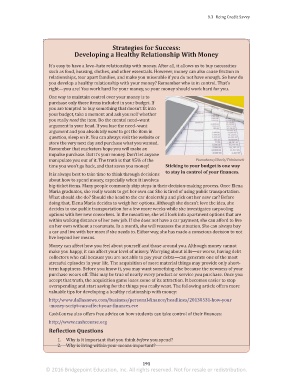
                          time you won’t go back, and that saves you money!  Sticking to your budget is one way
                                                                          to stay in control of your finances.
                          It is always best to take time to think through decisions
                          about how to spend money, especially when it involves
                          big-ticket items. Many people commonly skip steps in their decision-making process. Once Elena
                          Maria graduates, she really wants to get her own car. She is tired of using public transportation.
                          What should she do? Should she head to the car dealership and pick out her new car? Before
                          doing that, Elena Maria decides to weigh her options. Although she doesn’t love the idea, she
                          decides to use public transportation for a few more weeks while she investigates carpooling
                          options with her new coworkers. In the meantime, she will look into apartment options that are
                          within walking distance of her new job. If she does not have a car payment, she can afford to live
                          on her own without a roommate. In a month, she will reassess the situation. She can always buy
                          a car and live with her mom if she needs to. Either way, she has made a conscious decision to not
                          live beyond her means.
                          Money can affect how you feel about yourself and those around you. Although money cannot
                          make you happy, it can affect your level of misery. Worrying about bills—or worse, having debt
                          collectors who call because you are not able to pay your debts—can generate one of the most
                          stressful episodes in your life. The acquisition of more material things may provide only short-
                          term happiness. Before you know it, you may want something else because the newness of your
                          purchase wears off. This may be true of nearly every product or service you purchase. Once you
                          accept that truth, the acquisition game loses some of its attraction. It becomes easier to stop
                          overspending and start saving for the things you really want. The following article offers more
                          valuable tips for developing a healthy relationship with money:
                          http:/www.dallasnews.com/business/personal-finance/headlines/20130531-how-your
                          -money-script-can-affect-your-finances.ece
                          CashCourse also offers free advice on how students can take control of their finances:
                          http://www.cashcourse.org
                          Reflection Questions

                             1.  Why is it important that you think before you spend?
                             2.  Why is living within your means important?


                                                                 191
                        © 2016 Bridgepoint Education, Inc. All rights reserved. Not for resale or redistribution.


       sol82612_09_m09_171-194.indd   191                                                                            6/29/16   5:20 PM

