


Page 204 - digitalliteracy
P. 204
9.3  Being Credit Savvy


                       key to establishing good credit. For example, a student credit card may not charge any fees for
                       a first late payment, and there may be no over-limit fees and no annual fee.

                       Be wary of balance transfer credit cards. These cards often boast very low or even zero inter-
                       est rates, but only for the first 6 months or so—then the interest rate increases substantially.
                       If you think you can simply move your balance from one card to another in an effort to pay no
                       interest on your balance, think again; it will wreak havoc with your credit score. Every time
                       you sign up for a new credit card, the new credit card company checks your credit file, which
                       creates a hard credit inquiry. An increase in the number of hard credit inquiries is detrimental
                       to your credit score.


                       Protecting Your Credit


                       Identity theft  occurs when someone uses your
                       stolen data to obtain goods or services. There are
                       two types of identity theft. In one, someone steals
                       your credit card information and uses it to purchase
                       goods or services. In another, someone gains access
                       to your personal information (e.g., your Social Secu-
                       rity number, mother’s maiden name, date of birth,
                       and so on) and uses it to open new credit accounts
                       in your name without your knowledge. The results
                       of such criminal behavior can be financially devas-
                       tating, and it may take years to undo the damage.
                       According to the Fair Credit Billing Act, credit card
                       issuers  can  only hold you liable  for the first $50
                       charged on a lost or stolen credit card. If you report
                       the loss prior to the card being used or if your credit
                       card number (not the actual  card) is stolen, you
                       are not responsible for any losses. In reality, most
                       credit card companies do not hold their customers
                       liable for any amount, but it is your responsibility to
                       report a lost or stolen credit card promptly. In addi-
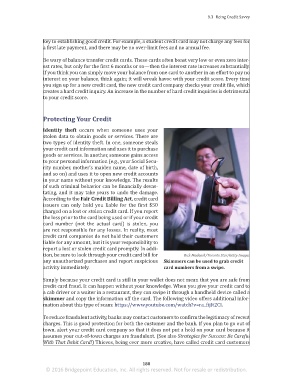
                       tion, be sure to look through your credit card bill for    Rick Madonik/Toronto Star/Getty Images
                       any unauthorized purchases and report suspicious  Skimmers can be used to grab credit
                       activity immediately.                              card numbers from a swipe.

                       Simply because your credit card is still in your wallet does not mean that you are safe from
                       credit card fraud. It can happen without your knowledge. When you give your credit card to
                       a cab driver or a waiter in a restaurant, they can swipe it through a handheld device called a
                       skimmer and copy the information off the card. The following video offers additional infor-
                       mation about this type of scam: https://www.youtube.com/watch?v=ra_fijIt2CI.

                       To reduce fraudulent activity, banks may contact customers to confirm the legitimacy of recent
                       charges. This is good protection for both the customer and the bank. If you plan to go out of
                       town, alert your credit card company so that it does not put a hold on your card because it
                       assumes your out-of-town charges are fraudulent. (See also Strategies for Success: Be Careful
                       With That Debit Card!) Thieves, being ever more creative, have called credit card customers


                                                                 188
                        © 2016 Bridgepoint Education, Inc. All rights reserved. Not for resale or redistribution.


       sol82612_09_m09_171-194.indd   188                                                                            6/29/16   5:19 PM

