


Page 215 - digitalliteracy
P. 215
10.1  Getting Your Personal Finances in Order


                       Assess Your Finances With an Income and Expenditure Statement


                       Before we can create your budget, we need to track your income and expenditures; in other
                       words, the amount of money you make versus the amount you spend. We can do this in an
                       income and expenditure statement, which reflects your finances over a certain period of
                       time, usually a month or a year. Let’s begin by calculating your expenses for one month.

                       We start with your income from your employer and then deduct income taxes and Social Secu-
                       rity taxes to calculate your after-tax income. If we divide that figure by 12, we get your monthly
                       take-home pay. Then we identify all of your monthly expenditures and track them for 1 month.
                       Most people are not aware of where their money actually goes; after this exercise you’ll have a
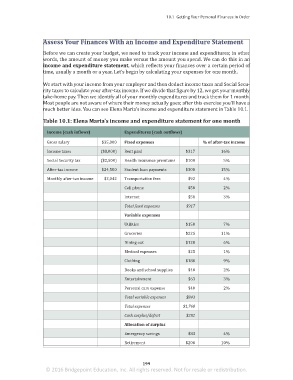
                       much better idea. You can see Elena Maria’s income and expenditure statement in Table 10.1.
                       Table 10.1: Elena Maria’s income and expenditure statement for one month

                         Income (cash inflows)           Expenditures (cash outflows)

                         Gross salary           $35,000  Fixed expenses                   % of after-tax income

                         Income taxes          ($8,000)  Rent paid                 $317           16%
                         Social Security tax   ($2,500)  Health insurance premiums  $100           5%
                         After-tax income       $24,500  Student loan payments     $300           15%

                         Monthly after-tax income  $2,042  Transportation fees      $92            4%
                                                         Cell phone                 $50            2%

                                                         Internet                   $58            3%
                                                         Total fixed expenses      $917
                                                         Variable expenses

                                                         Utilities                 $150            7%
                                                         Groceries                 $225           11%

                                                         Dining out                $120            6%
                                                         Medical expenses           $25            1%
                                                         Clothing                  $180            9%

                                                         Books and school supplies  $40            2%
                                                         Entertainment              $63            3%
                                                         Personal care expense      $40            2%
                                                         Total variable expenses   $843

                                                         Total expenses           $1,760
                                                         Cash surplus/deficit      $282
                                                         Allocation of surplus

                                                         Emergency savings          $83            4%

                                                         Retirement                $200           10%


                                                                 199
                        © 2016 Bridgepoint Education, Inc. All rights reserved. Not for resale or redistribution.


       sol82612_10_m10_195-210.indd   199                                                                            6/29/16   5:20 PM

