


Page 82 - digitalliteracy
P. 82
4.1 Digital Citizenship and Etiquette Awareness


                   What type of digital citizen are you? Do you meet the criteria listed? In what areas could you
                   improve to be a better digital citizen?


                   A Good Digital Citizen Understands and Avoids Plagiarism

                   Digital citizenship translates to your online college classroom in that good digital student–
                   citizens practice academic integrity. They conform to the academic integrity policies and stu-
                   dent community standards in the university catalog available on the Student Portal home
                   page. They avoid plagiarism, which occurs when a writer uses someone else’s language,
                   ideas, or other original (non-common-knowledge) material without acknowledging its source
                   (Council of Writing Program Administrators, 2003). They use critical thinking to formulate
                   responses to assignments and to develop academic papers.


                   Plagiarism is a serious  offense.  When you repre-
                   sent another’s work as your own or closely copy the
                   language or arrangement of a document that is not
                   yours, you are stealing other people’s work. Most
                   organizations and academic institutions, including
                   Ashford University, have strict policies prohibiting
                   plagiarism. Faculty members are required to report
                   suspected plagiarism,  and a formal investigation
                   is conducted. If you are found guilty, the penalties
                   are severe and may result in a failing grade on the
                   assignment, a failing  grade for  the class, suspen-
                   sion from the university, or expulsion. Such conse-
                   quences are a stain on your academic record and
                   a  blemish on your integrity and  your reputation.
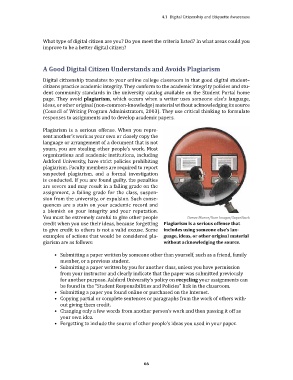
                   You must be extremely careful to give other people          Danae Munoz/Ikon Images/SuperStock
                   credit when you use their ideas, because forgetting  Plagiarism is a serious offense that
                   to give credit to others is not a valid excuse. Some  includes using someone else’s lan-
                   examples of actions that would be considered pla-  guage, ideas, or other original material
                   giarism are as follows:                           without acknowledging the source.

                        •  Submitting a paper written by someone other than yourself, such as a friend, family
                          member, or a previous student.
                        •  Submitting a paper written by you for another class, unless you have permission
                          from your instructor and clearly indicate that the paper was submitted previously
                          for another purpose. Ashford University’s policy on recycling your assignments can
                          be found in the “Student Responsibilities and Policies” link in the classroom.
                        •  Submitting a paper you found online or purchased on the Internet.
                        •  Copying partial or complete sentences or paragraphs from the work of others with-
                          out giving them credit.
                        •  Changing only a few words from another person’s work and then passing it off as
                          your own idea.
                        •  Forgetting to include the source of other people’s ideas you used in your paper.


                                                             66

