


Page 30 - ArithBook5thEd ~ BCC
P. 30
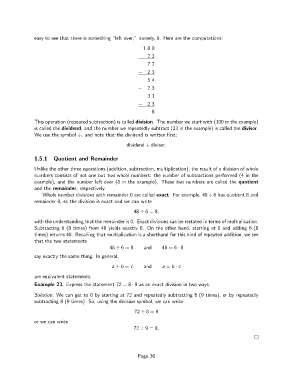
easy to see that there is something “left over,” namely, 8. Here are the computations:

                                                             100
                                                           − 23
                                                               77
                                                           − 23
                                                               54
                                                           − 23
                                                               31
                                                           − 23
                                                                 8

               This operation (repeated subtraction) is called division. The number we start with (100 in the example)
               is called the dividend, and the number we repeatedly subtract (23 in the example) is called the divisor.
               We use the symbol ÷, and note that the dividend is written first:

                                                      dividend ÷ divisor.


               1.5.1   Quotient and Remainder
               Unlike the other three operations (addition, subtraction, multiplication), the result of a division of whole
               numbers consists of not one but two whole numbers: the number of subtractions performed (4 in the
               example), and the number left over (8 in the example). These two numbers are called the quotient
               and the remainder, respectively.
                   Whole number divisions with remainder 0 are called exact.For example, 48 ÷ 6has quotient 8and
               remainder 0, so the division is exact and we can write
                                                         48 ÷ 6= 8,

               with the understanding that the remainder is 0. Exact divisions can be restated in terms of multiplication.
               Subtracting 6 (8 times) from 48 yields exactly 0. On the other hand, starting at 0 and adding 6 (8
               times) returns 48. Recalling that multiplication is a shorthand for this kind of repeated addition, we see
               that the two statements
                                               48 ÷ 6= 8     and     48 = 6 · 8
               say exactly the same thing. In general,

                                                a ÷ b = c    and     a = b · c

               are equivalent statements.
               Example 23. Express the statement 72 = 8 · 9as an exact division in twoways.
               Solution. We can get to 0 by starting at 72 and repeatedly subtracting 8 (9 times), or by repeatedly
               subtracting 8 (9 times). So, using the division symbol, we can write

                                                         72 ÷ 8= 9
               or we can write
                                                         72 ÷ 9= 8.


                                                           Page 30

