


Page 31 - ArithBook5thEd ~ BCC
P. 31
Example 24. The division 63 ÷ 7 is exact. Express this fact using an appropriate multiplication.

               Solution. Since the quotient is 9 and the remainder is 0, we can write


                                               63 ÷ 7= 9      or    63= 9 · 7.


               1.5.2   Long Division
               Divisions with multi-digit divisors and/or dividends can get complicated, so we remind you of a standard
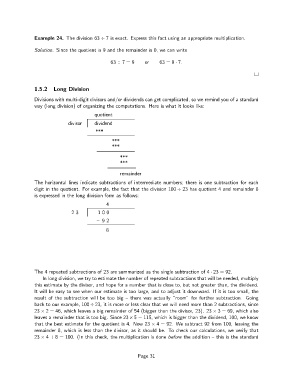
               way (long division) of organizing the computations. Here is what it looks like:
                                         quotient

                              divisor    dividend
                                         ***
                                                ***
                                                ***
                                                   ***
                                                   ***

                                                   remainder
               The horizontal lines indicate subtractions of intermediate numbers; there is one subtraction for each
               digit in the quotient. For example, the fact that the division100 ÷ 23 has quotient 4 and remainder 8
               is expressed in the long division form as follows:

                                             4
                               23         10 0
                                         − 92
                                             8


               The 4 repeated subtractions of 23 are summarized as the single subtraction of 4 · 23 = 92.
                   In long division, we try to estimate the number of repeated subtractions that will be needed, multiply
               this estimate by the divisor, and hope for a number that is close to, but not greater than, the dividend.
               It will be easy to see when our estimate is too large, and to adjust it downward. If it is too small, the
               result of the subtraction will be too big – there was actually “room” for further subtraction. Going
               back to our example, 100 ÷ 23, it is more or less clear that we will need more than 2 subtractions, since
               23 × 2 = 46, which leaves a big remainder of 54 (bigger than the divisor, 23). 23 × 3= 69, which also
               leaves a remainder that is too big. Since 23×5= 115, which is bigger than the dividend, 100, we know
               that the best estimate for the quotient is 4. Now 23 × 4 = 92. We subtract 92 from 100, leaving the
               remainder 8, which is less than the divisor, as it should be. To check our calculations, we verify that
               23 × 4+ 8 = 100. (In this check, the multiplication is done before the addition – this is the standard


                                                           Page 31

