


Page 38 - ArithBook5thEd ~ BCC
P. 38
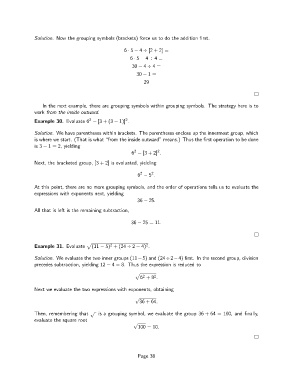
Solution. Now the grouping symbols (brackets) force us to do the addition first.

                                                     6 · 5 − 4 ÷ [2 + 2] =
                                                       6 · 5 − 4 ÷ 4=

                                                        30 − 4 ÷ 4=
                                                          30 − 1=
                                                             29


                   In the next example, there are grouping symbols within grouping symbols. The strategy here is to
               work from the inside outward.
                                      2
                                                     2
               Example 30. Evaluate 6 − [3 + (3 − 1)] .
               Solution. We have parentheses within brackets. The parentheses enclose up the innermost group, which
               is where we start. (That is what “from the inside outward” means.) Thus the first operation to be done
               is 3 − 1= 2, yielding
                                                                   2
                                                         2
                                                        6 − [3 + 2] .
               Next, the bracketed group, [3 + 2] is evaluated, yielding

                                                                2
                                                            2
                                                           6 − 5 .
               At this point, there are no more grouping symbols, and the order of operations tells us to evaluate the
               expressions with exponents next, yielding
                                                          36 − 25.
               All that is left is the remaining subtraction,

                                                        36 − 25 = 11.


                                     !
                                               2
                                                              2
               Example 31. Evaluate    (11 − 5) +(24 ÷ 2 − 4) .
               Solution. We evaluate the two inner groups (11−5) and (24÷2−4) first. In the second group, division
               precedes subtraction, yielding 12 − 4 = 8. Thus the expression is reduced to

                                                         !
                                                                 2
                                                             2
                                                            6 +8 .
               Next we evaluate the two expressions with exponents, obtaining
                                                         √
                                                           36 + 64.

               Then, remembering that  √  is a grouping symbol, we evaluate the group 36 + 64 = 100, and finally,
               evaluate the square root
                                                         √
                                                           100 = 10.


                                                           Page 38

