


Page 40 - ArithBook5thEd ~ BCC
P. 40
1.8.1   Exercises

               Find the average of each of the following multi-sets of numbers.


                1. {1, 2, 3, 4, 5, 6, 7}

                2. {13, 13, 19, 15}

                3. {206, 196, 204}


                4. {85, 81, 92}
                5. A baseball team had 7 games cancelled due to rain in the 2010 season. The number of cancelled
                   games in the 2002-2009 seasons were 5, 6, 2, 10, 9, 4, 6, 5. What was the average number of
                   cancelled games for the 2002-2010 seasons?

                6. Suppose the average of the multi-set {20, 22, N,28} is 25, where N stands for an unknown number.
                   Find the value of N.


               1.9     Perimeter, Area and the Pythagorean Theorem


               Squares and rectangles are examples of polygons – closed shapes that can be drawn on a flat surface,
               using segments of straight lines which do not cross each other. “Closed” means that the line segments
               form a boundary, with no gaps, which encloses a unique “inside” region, and separates it from the
               “outside” region.
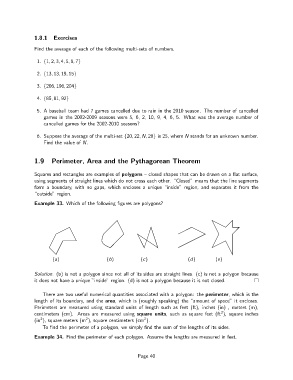
               Example 33. Which of the following figures are polygons?


                       (a)                    (b)           (c)                 (d)        (e)


               Solution. (b) is not a polygon since not all of its sides are straight lines.(c) is not a polygon because
               it does not have a unique ”inside” region. (d) is not a polygon because it is not closed.


                   There are two useful numerical quantities associated with a polygon: the perimeter,which is the
               length of its boundary, and the area, which is (roughly speaking) the “amount of space” it encloses.
               Perimeters are measured using standard units of length such as feet (ft), inches (in) , meters (m),
                                                                                             2
               centimeters (cm). Areas are measured using square units, such as square feet (ft ), square inches
                                     2
                  2
                                                             2
               (in ), square meters (m ), square centimeters (cm ).
                   To find the perimeter of a polygon, we simply find the sum of the lengths of its sides.
               Example 34. Find the perimeter of each polygon. Assume the lengths are measured in feet.


                                                           Page 40

