


Page 12 - SOLAR SYSTEM
P. 12
The F' arthest planet


            r-r-

            /  I  The lac;t of the Solar Syc;tern'c;
            eight planetc;  ic;  Neptune.  It is the
            smallest of the gas giants, but still

            nearly four times bigger than  Earth.
         ,  Like Uranus, it is an  icy world made

            of hydrogen and helium, as well as
            water, ammonia and  methane.


            7 8 Neptune was  the rir-st planet round             .   '
                                                                . )_i;ir,
            by mathematics. Astronomers noticed that Uranus      .. :J-4,..   ...... ...
                                                                                .
            was being tugged by the gravity of another large       '''\1~  ·•
         ,  body, which affected its orbit. Calculations showed
            astronomers where to look, and in 1846, Neptune
            was found.

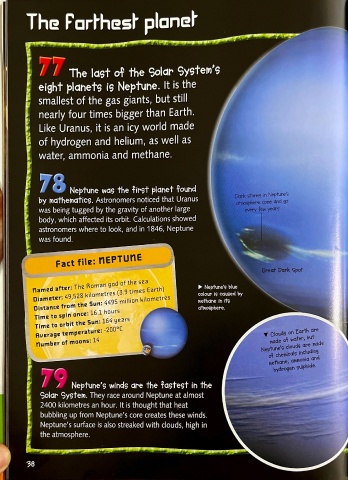
                 fact file: nePTUnE


          named after: The P.oman god of the sea          Neprune's blue
          Diameter: 49,528 kilometres (3.9 times Earth)   colour is caused by
          Distance tram the Sun: 4495 million kilometres   methane  in its
                                                        atmosphere.
          Time to spin once: 16.1 hours
           Time to orbit the Sun: 164 years
           Average temperature: -200°[                                    •  C\audc..  on t;ar"lt, are
           number of moons: 14                                              tn<1de   'llater, 1,ut
                                                                          Neptune'C.. clouds are made
                                                                              chemica\c,  including
                                                                            ine"lt,ane, am111onia  and
             r-r                                                             hycll'O'ilen c,ulphide.

             /   /   Neptune's winds ar-e  the rastest in the
            Solar- System. They race around Neptune at almost
            2400 kilometres an hour. It is thought that heat
            bubbling up from  Neptune's core creates these winds.
            Neptune's surface is also streaked with clouds,  high in
            the atmosphere.

