


Page 9 - SOLAR SYSTEM
P. 9
wr:s          s


                                                           has been exp/of"ing c--1-..
                                                          and ·t             ;x.i,urn
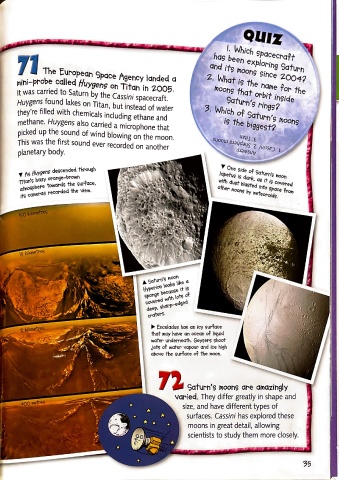
      ,1 The l'.uro~eao S~ace flger,cy laoded a               , s moons  since  zoo47
      mini-probe  called Huygeng on Titan in  'Z-005.    Z.  What is  the name  .n   "'"'-
                                                                             Tor  , ne
                                                           moon  "'"'-
      It was carried to Saturn by the Cassini spacecraft.      s , nat Of"bit inside
      Huygens found lakes on Titan, but instead of water      Saturn's f"ihgs?
      they're filled with chemicals including ethane and   3.  Which  o-P  Sa-1-. ·rh'
                                                              .
                                                                      ,u  s moons
      methane. Huygens also carried a microphone that         1 s the biggest'(
      picked  up the sound of wind blowing on the moon.
      This was the first sound ever recorded on another
      planetary body.

               descended thro119h
        /'IS  Huy9en<; ran9e-brov,n                                   Satvr-n's moon
      ~tcln'S ha'tY  o  rds the surrace,                              as it Is cover-eel
      "   h  e tov,Cl
      atinoSI'  er  recorded the viev,.                               ci  into SJ>ace  fr-om
       its cameras                                                    eteor-o;c1s.


                                             •s "'oon
                                        •  saturn oo\:,s \i\<.e  a
                                        \\yperion I  ause it iS
                                        gpanse ~i'l\l \ots di
                                        covered   -edsed
                                         dee!', sne1rp
                                         craterS-
                                           enceladus  has an  icy surface
                                          that inay have an ocean o\!  lictuid
                                          v,ater underneath.  Geysers shoot
                                          Jets o\!  v,ater va1>our  and  ice high
                                          above the surface o\!  the tnoon.


                                            n Saturn's  frlOOhS  are arria-zingly
                                                varied. They differ greatly in shape and
                                                  size, and have different types of
                                                    surfaces. Cassini has explor~d these
                                                    moons in great detail, allowing
                                                    scientists to study them  more closely.


                                                                                   '35

