


Page 4 - SOLAR SYSTEM
P. 4
Jupiter's moons


            s a Ju1>iter has  more  moons  than

            any  other- ~lanet.  This  is  because of its
            huge size,  as  it means  it has  a very strong
            pull of gravity.  So far,  67 moons have
            been  discovered. The four biggest can  be
         :,I
            seen  with binoculars. They're known as the
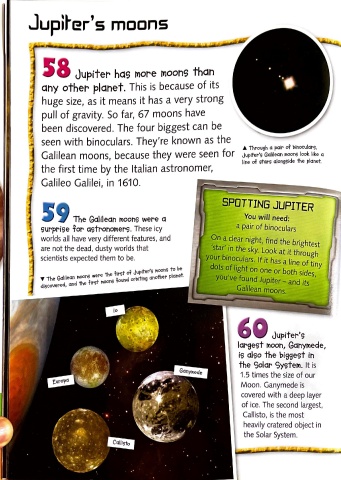
                                                                 Jt.  Through a pair ol'  binoculars,
            Galilean  moons,  because they were seen  for        Jupiter's Galilean moons  look like  a
                                                                 line ol'  stars alongside  the planet.
         '  the first time by the Italian astronomer,

            Galileo Galilei,  in  1610.


            S 9 The  Galilean moons  were  a                      You will need:
            surprise ror astronomers. These icy                a pair of binoculars
            worlds all  have very different features,  and   ~/ear night, find the brightest
            are not the dead, dusty worlds that              _m  the sky.  Look at it through
            scientists expected them to be.                  no~ulars. If it has a line of tiny
                             th  hst ol'  Jupiter's moons  to be   t on one or both sides
            'f The Galilean moons  were   e   d  rbiting another planet.   und Jupiter - and i   '
                        hst moons  ,oun  °
            discovered, an  d th  e   1


                                                                ,o Jupiter's
                                                                largest moon,  Ganymede,
                                                                is  also the bi99est in
                                                                the Solar System.  It is
                                                                 1.5 times the size of our
                                                                 Moon. Ganymede is
                                                                 covered with a deep layer
                                                                 of ice. The second  largest,
                                                                 Callisto,  is the most
                                                                 heavily cratered object in
                                                                  the Solar System.

