


Page 201 - text book form physics kssm 2020
P. 201
Chapter 5
                                                                                                  Waves
                   2.  Switch on the ripple generator and adjust so that plane waves of low frequency
                      are produced.
                   3.  Observe the plane wavefront produced.
                   4.  Place the perspex sheet into the water as shown in Figure 5.34 so that the wave
                      propagates from the deep region to the shallow region of the water.
                   5.  Observe the movement of the wavefront in the deep and shallow regions.
                   6.  Adjust the frequency of the stroboscope to freeze the movement of the wave.
                      Observe the pattern of the waves.
                   7.  Use a marker pen to mark on the plastic sheet the position of:
                      (a)  boundary between the deep and the shallow regions
                      (b)  three consecutive incident wavefronts
                      (c)  three consecutive refracted wavefronts
                   8.  Remove the plastic sheet and use a marker pen to draw:
                      (a)  boundary between the deep and the shallow regions
                      (b)  three incident wavefronts and refracted wavefronts
                      (c)  direction of propagation of incident wave and refracted wave
                      (d) normal line
                   9.  Determine the following values:
                      (a)  angle of incidence, i and angle of refraction, r
                      (b)  incident wavelength and refracted wavelength
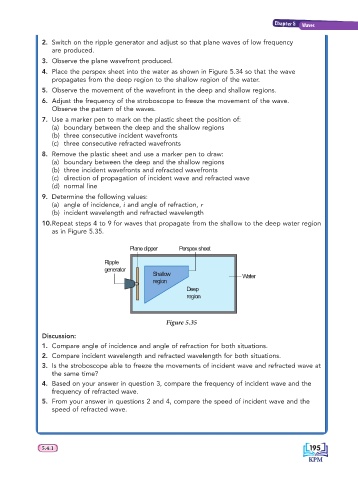
                   10. Repeat steps 4 to 9 for waves that propagate from the shallow to the deep water region
                      as in Figure 5.35.


                                              Plane dipper   Perspex sheet
                                      Ripple
                                      generator
                                                     Shallow                    Water
                                                     region
                                                               Deep
                                                               region


                                                         Figure 5.35
                   Discussion:
                   1.  Compare angle of incidence and angle of refraction for both situations.
                   2.  Compare incident wavelength and refracted wavelength for both situations.
                   3.  Is the stroboscope able to freeze the movements of incident wave and refracted wave at
                      the same time?
                   4.  Based on your answer in question 3, compare the frequency of incident wave and the
                      frequency of refracted wave.
                   5.  From your answer in questions 2 and 4, compare the speed of incident wave and the
                      speed of refracted wave.


                                                                                                    195
                                                                                                    195
                   3.2.2
                   5.4.1
                   5.4.1

