


Page 205 - text book form physics kssm 2020
P. 205
Chapter 5
                                                                                                  Waves
                        During the day, air that is closer to the surface of the earth is hotter than the air above.
                  Sound moves faster in hot air than in cold air. As such, sound is refracted away from the ground.
                  Th  us, an observer cannot hear sound clearly during the daytime.


                                            Cold air
                                                                    Refraction away from the ground


                                                                           Observer hears sound
                                                    Hot air                which is weaker
                                                            Daytime

                                        Figure 5.39 Sound is not heard clearly during the day
                        During the night, air that is closer to the surface of the earth is colder. Sound is refracted
                  towards the ground. Th  is causes the observer to hear sound more clearly during the night.
                  Observe Figure 5.40.


                                                 Hot air


                                                                   Refraction towards the ground

                                                                           Observer hears sounds
                                                 Cold air                  which are louder
                                                           Night-time
                                       Figure 5.40 Sound is heard more clearly during the night

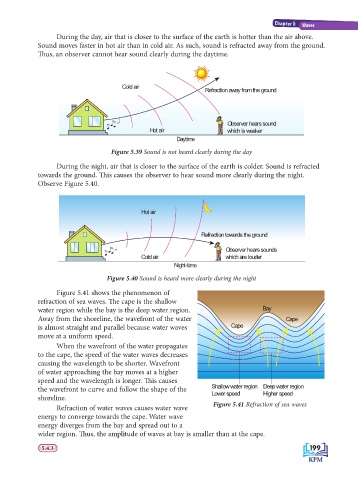
                        Figure 5.41 shows the phenomenon of
                  refraction of sea waves. Th  e cape is the shallow
                  water region while the bay is the deep water region.                Bay
                  Away from the shoreline, the wavefront of the water                        Cape
                  is almost straight and parallel because water waves       Cape
                  move at a uniform speed.
                        When the wavefront of the water propagates
                  to the cape, the speed of the water waves decreases
                  causing the wavelength to be shorter. Wavefront
                  of water approaching the bay moves at a higher
                  speed and the wavelength is longer. Th is causes
                  the wavefront to curve and follow the shape of the   Shallow water region Deep water region
                                                                                      Higher speed
                                                                      Lower speed
                  shoreline.
                                                                       Figure 5.41 Refraction of sea waves
                        Refraction of water waves causes water wave
                  energy to converge towards the cape. Water wave
                  energy diverges from the bay and spread out to a
                  wider region. Th  us, the amplitude of waves at bay is smaller than at the cape.

                                                                                                    199
                                                                                                    199
                   5.4.3
                   5.4.3

