


Page 220 - text book form physics kssm 2020
P. 220
In Activity 5.19, can you identify the constructive and destructive interferences for water,
                 light and sound waves?


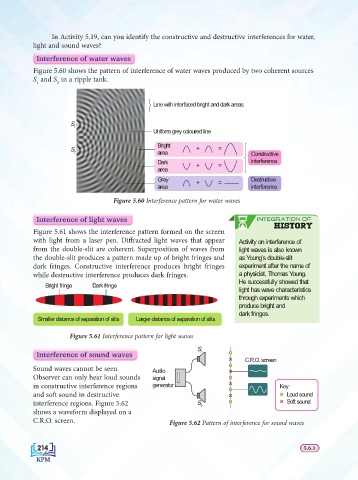
                 Figure 5.60 shows the pattern of interference of water waves produced by two coherent sources
                 S  and S  in a ripple tank.
                  1     2

                                                     Line with interfaced bright and dark areas


                            S
                             1
                                                     Uniform grey coloured line
                                                      Bright
                            S                                     +     =
                             2                        area                        Constructive
                                                      Dark        +     =               interference
                                                      area
                                                      Grey        +     =         Destructive
                                                      area                        interference

                                         Figure 5.60 Interference pattern for water waves

                                                                                    INTEGRATION OF
                                                                                         HISTORY
                 Figure 5.61 shows the interference pattern formed on the screen
                 with light from a laser pen. Diff racted light waves that appear   Activity on interference of
                 from the double-slit are coherent. Superposition of waves from   light waves is also known
                 the double-slit produces a pattern made up of bright fringes and   as Young’s double-slit
                 dark fringes. Constructive interference produces bright fringes   experiment after the name of
                 while destructive interference produces dark fringes.         a physicist, Thomas Young.
                                                                               He successfully showed that
                    Bright fringe  Dark fringe
                                                                               light has wave characteristics
                                                                               through experiments which
                                                                               produce bright and
                                                                               dark fringes.
                  Smaller distance of separation of slits  Larger distance of separation of slits

                            Figure 5.61 Interference pattern for light waves
                                                                  S
                                                                   1
                                                                                C.R.O. screen
                 Sound waves cannot be seen.         Audio
                 Observer can only hear loud sounds   signal
                 in constructive interference regions   generator                          Key:
                 and soft  sound in destructive                                              Loud sound
                 interference regions. Figure 5.62                S 2                        Soft sound
                 shows a waveform displayed on a
                 C.R.O. screen.                           Figure 5.62 Pattern of interference for sound waves


                  214
                  214                                                                             5.6.1
                                                                                                  5.6.1

