


Page 249 - text book form physics kssm 2020
P. 249
Chapter 6
                                                                                               Light and Optics
                   7.  Remove the glass block. Draw the incident ray and measure the angle of incidence. This
                      angle of incidence is known as the critical angle of glass, c.
                   8.  Place the glass block back to its original position. Observe the refracted ray and
                      refl ected ray when:
                      (a)  angle of incidence is smaller than the critical angle, and
                      (b)  angle of incidence is larger than the critical angle.
                   Discussion:
                   1.  What is the critical angle of glass?
                   2.  Describe the propagation of light ray through the glass block when the angle of
                      incidence is smaller than the critical angle.
                   3.  What happens to the light ray travelling through the glass block when
                      (a)  the angle of incidence is smaller than the critical angle?
                      (b)  the angle of incidence is larger than the critical angle?


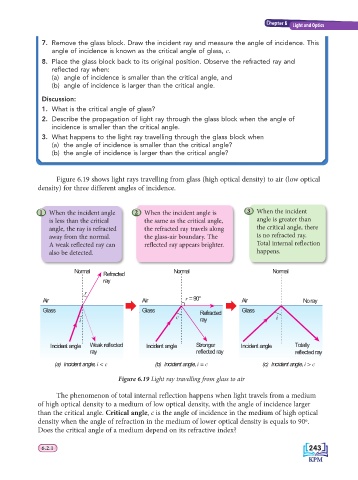
                        Figure 6.19 shows light rays travelling from glass (high optical density) to air (low optical
                  density) for three different angles of incidence.


                   1   When the incident angle   2   When the incident angle is   3   When the incident
                      is less than the critical   the same as the critical angle,   angle is greater than
                      angle, the ray is refracted   the refracted ray travels along   the critical angle, there
                      away from the normal.       the glass-air boundary. The       is no refracted ray.
                      A weak reflected ray can    reflected ray appears brighter.   Total internal reflection
                      also be detected.                                             happens.


                             Normal   Refracted            Normal                        Normal
                                      ray
                                r
                    Air                           Air          r = 90°         Air                No ray
                    Glass                         Glass            Refracted   Glass
                                                            c                             i
                               i                                   ray


                      Incident angle  Weak reflected  Incident angle  Stronger  Incident angle  Totally

                                  ray                             reflected ray                reflected ray
                       (a) Incident angle, i < c     (b) Incident angle, i = c        (c) Incident angle, i > c

                                          Figure 6.19 Light ray travelling from glass to air

                        The phenomenon of total internal reflection happens when light travels from a medium
                  of high optical density to a medium of low optical density, with the angle of incidence larger
                  than the critical angle. Critical angle, c is the angle of incidence in the medium of high optical
                  density when the angle of refraction in the medium of lower optical density is equals to 90º.
                  Does the critical angle of a medium depend on its refractive index?

                                                                                                    243
                   6.2.1
                   6.2.1                                                                            243

