


Page 286 - text book form physics kssm 2020
P. 286
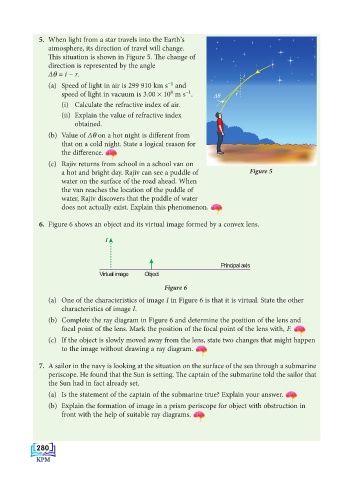
5.  When light from a star travels into the Earth’s
                     atmosphere, its direction of travel will change.
                     Th  is situation is shown in Figure 5. Th  e change of
                     direction is represented by the angle
                     Δθ = i − r.                                                i
                                                         −1
                     (a)  Speed of light in air is 299 910 km s  and
                                                               −1
                                                          8
                         speed of light in vacuum is 3.00 × 10  m s .   ¨ș    r
                         (i)  Calculate the refractive index of air.
                         (ii)  Explain the value of refractive index
                             obtained.
                     (b) Value of Δθ on a hot night is diff erent from
                         that on a cold night. State a logical reason for
                         the diff erence.
                     (c)  Rajiv returns from school in a school van on
                         a hot and bright day. Rajiv can see a puddle of          Figure 5
                         water on the surface of the road ahead. When
                         the van reaches the location of the puddle of
                         water, Rajiv discovers that the puddle of water
                         does not actually exist. Explain this phenomenon.

                  6.  Figure 6 shows an object and its virtual image formed by a convex lens.

                                       I


                                                                         Principal axis
                                     Virtual image  Object


                                                        Figure 6
                     (a)  One of the characteristics of image I in Figure 6 is that it is virtual. State the other
                         characteristics of image I.
                     (b)  Complete the ray diagram in Figure 6 and determine the position of the lens and
                         focal point of the lens. Mark the position of the focal point of the lens with, F.
                     (c)  If the object is slowly moved away from the lens, state two changes that might happen
                         to the image without drawing a ray diagram.


                  7.  A sailor in the navy is looking at the situation on the surface of the sea through a submarine
                     periscope. He found that the Sun is setting. Th  e captain of the submarine told the sailor that
                     the Sun had in fact already set.
                     (a)  Is the statement of the captain of the submarine true? Explain your answer.
                     (b)  Explain the formation of image in a prism periscope for object with obstruction in
                         front with the help of suitable ray diagrams.


                  280
                  280

