


Page 87 - text book form physics kssm 2020
P. 87
Chapter 3
                                                                                                  Gravitation
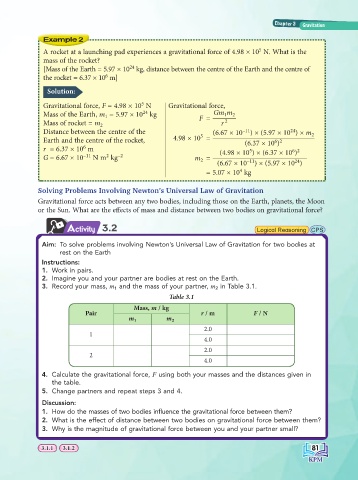
                    Example 2
                                                                                     5
                    A rocket at a launching pad experiences a gravitational force of 4.98 × 10  N. What is the
                    mass of the rocket?
                                              24
                    [Mass of the Earth = 5.97 × 10  kg, distance between the centre of the Earth and the centre of
                                      6
                    the rocket = 6.37 × 10  m]
                     Solution:

                                                 5
                    Gravitational force, F = 4.98 × 10  N  Gravitational force,
                                                  24
                    Mass of the Earth, m  = 5.97 × 10  kg          F =   Gm m 2
                                                                          1
                                      1
                    Mass of rocket = m 2                                 r  2
                    Distance between the centre of the                 (6.67 × 10 –11 ) × (5.97 × 10 ) × m
                                                                                              24
                                                                                                    2
                                                                   5
                    Earth and the centre of the rocket,     4.98 × 10  =        (6.37 × 10 )
                                                                                         6 2
                                6
                    r = 6.37 × 10  m                                     (4.98 × 10 ) × (6.37 × 10 )
                                                                                               6 2
                                                                                  5
                                       2
                    G = 6.67 × 10 –11  N m  kg –2                m  =
                                                                   2
                                                                                               24
                                                                        (6.67 × 10 –11 ) × (5.97 × 10 )
                                                                               4
                                                                       = 5.07 × 10  kg
                  Solving Problems Involving Newton’s Universal Law of Gravitation
                  Gravitational force acts between any two bodies, including those on the Earth, planets, the Moon
                  or the Sun. What are the eff ects of mass and distance between two bodies on gravitational force?
                           Activity 3.2                                             Logical Reasoning CPS
                   Aim:  To solve problems involving Newton’s Universal Law of Gravitation for two bodies at
                         rest on the Earth
                   Instructions:
                   1.  Work in pairs.
                   2.  Imagine you and your partner are bodies at rest on the Earth.
                   3.  Record your mass, m  and the mass of your partner, m  in Table 3.1.
                                         1
                                                                        2
                                                          Table 3.1
                                               Mass, m / kg
                                Pair                               r / m           F / N
                                             m 1         m 2
                                                                    2.0
                                  1
                                                                    4.0
                                                                    2.0
                                  2
                                                                    4.0
                   4.  Calculate the gravitational force, F using both your masses and the distances given in
                      the table.
                   5.  Change partners and repeat steps 3 and 4.
                   Discussion:
                   1.  How do the masses of two bodies infl uence the gravitational force between them?
                   2.  What is the effect of distance between two bodies on gravitational force between them?
                   3.  Why is the magnitude of gravitational force between you and your partner small?


                   3.1.1
                   3.1.1  3.1.2                                                                      81 81 81 81
                          3.1.2

