


Page 19 - demo
P. 19
FEATURE


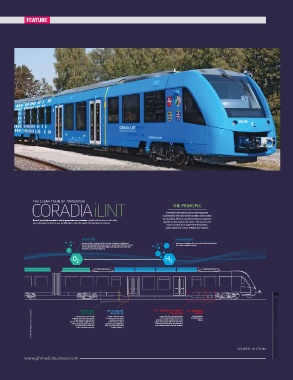
              CORADIA iLINT                                           Electricity for the traction and on-board equipment
               THE CLEAN TRAIN OF TOMORROW
                                                                         THE PRINCIPLE
                                                                     is generated by a fuel cell, stored in a battery and recovered
                                                                     during braking. All this is overseen by energy management
               Born of a global movement to reduce greenhouse gas emissions coupled with the desire to offer silent,   algorithms which optimise the system. This virtuous circle
               green alternatives to diesel on non-electrified lines, iLint is the world’s first low-floor, fuel cell train.
                                                                       makes Coradia iLint an unprecedented innovation.
                                                                      100% emission-free, it is the definitive green product.
                                   A FUEL CELL                            THE HYDROGEN,
                                   generates electrical energy via chemical reaction, combining a fuel (hydrogen)    stored as gas in holding tanks on the roof, is the fuel used by the fuel
                                   with a combustion agent (the oxygen in the air). The only exhaust? Water and steam.    cell. It will be supplied by a partner.
                                   The fuel cell powers the traction motor during acceleration and, at the same time,
                                   the batteries and on-board equipment..
                               0 2                                    H 2


                                                                                                                   19
                                                                                                                   19
                                                                                                                   19
                                  LITHIUM-ION   THE AUXILIARY    THE TRACTION INVERTER/  THE TRACTION
                                   BATTERIES   CONVERTER                CONVERTER   MOTOR
                                                                                 drives the wheels
                                                                    ensures that the appropriate energy
                                 store part of the extra energy   received from the fuel cell or    collects energy generated by the movement    for acceleration and
                                              converts electrical energy
              © Alstom, 2016 –Design and production:   under normal operation and can be   doors, passenger information   of the train during braking, redistributing it    | Global MDA Journal | NOV-DEC 2017
                               produced by the fuel cell as well as
                                                                    is transmitted between the fuel cell,
                                                                  the battery and the traction motor. It also
                                                                                    braking.
                                kinetic energy recovered during
                                               the battery to adapt it
                              braking. The batteries supply the train
                                              to the various on-board
                                             equipment (air conditioning,
                                                                  to the auxiliary converter and the batteries.
                                used to boost the acceleration
                                 of the train when necessary.
                                                displays, lighting…)
                                                                                                    SOURCE: ALSTOM
           www
           www.ghmediabusiness.com.ghmediabusiness.com
                                                                                                                    | Global MDA Journal | NOV-DEC 2017
                                                                                                                    | Global MDA Journal | NOV-DEC 2017

