


Page 20 - demo
P. 20
RESEARCH


            LASER-IMAGING TECHNOLOGY


            BROUGHT INTO FOCUS


            Caltech’s Lihong Wang unveils improved method for peering inside living creatures


            Caltech engineers have improved a technique for taking three-dimensional (3-D)
            microscopic images of tissue, allowing them to see inside living creatures with
            greater precision than before.
            by Emily Velasco


               he  technology,  called  3-D  photoacoustic  microscopy
            T(PAM),  bombards  tissue  with  a  laser  beam.  As  the
            energy in the laser light is absorbed, it causes the tissue
            to  vibra`te ultrasonically.  Those  vibrations  are picked  up
            by sensors and used to assemble an image of the tissue’s
            internal  structures  in  a  process  similar  to  ultrasound
            imaging.
            The  technique  was  invented  by  Lihong  Wang,  Caltech’s
            Professor of Medical Engineering and Electrical Engineering,
            and  his  team  in  the  Caltech  Optical  Imaging  Laboratory,
            part  of  the  Andrew  and  Peggy  Cherng  Department  of
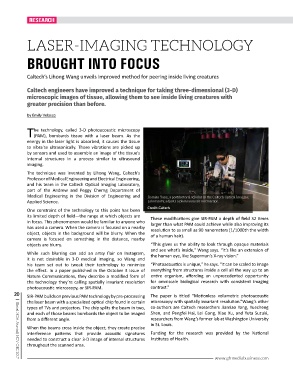
            Medical  Engineering  in  the  Division  of  Engineering  and   Jiamiao Yang, a postdoctoral scholar in the Caltech Optical Imaging
            Applied Science.                                   Laboratory, adjusts a photoacoustic microscope.
            One constraint of the technology to this point has been   Credit: Caltech
            its limited depth of field—the range at which objects are   These modifications give SIR-PAM a depth of field 32 times
            in focus. This phenomenon would be familiar to anyone who   larger than what PAM could achieve while also improving its
            has used a camera. When the camera is focused on a nearby   resolution to as small as 90 nanometers (1/1000th the width
            object, objects in the background will be blurry. When the   of a human hair).
            camera  is  focused  on  something  in  the  distance,  nearby
            objects are blurry.                                 “This gives us the ability to look through opaque materials
                                                                and see what’s inside,” Wang says. “It’s like an extension of
            While  such  blurring  can  add  an  artsy  flair  on  Instagram,   the human eye, like Superman’s X-ray vision.”
            it  is  not  desirable  in  3-D  medical  imaging,  so  Wang  and
            his  team  set  out  to  tweak  their  technology  to  minimize  “Photoacoustics is unique,” he says. “It can be scaled to image
            the  effect.  In  a  paper  published  in  the  October  3  issue  of  everything from structures inside a cell all the way up to an
            Nature Communications, they describe a modified form of  entire  organism,  affording  an  unprecedented  opportunity
            the  technology  they’re  calling  spatially  invariant  resolution  for  omniscale  biological  research  with  consistent  imaging
            photoacoustic microscopy, or SIR-PAM.               contrast.”
       20   SIR-PAM builds on previous PAM technology by pre-processing  The  paper  is  titled  “Motionless  volumetric  photoacoustic
            the laser beam with a specialized optical chip found in certain  microscopy with spatially invariant resolution.”Wang’s other
            types of TVs and projectors. The chip splits the beam in two,  co-authors are Caltech researchers Jiamiao Yang, Yuecheng
            and each of those beams bombards the object to be imaged  Shen, and Pengfei Hai, Lei Gong, Xiao Xu, and Yuta Suzuki,
            from a different angle.                             researchers from Wang’s former lab at Washington University
                                                                in St. Louis.
            When the beams cross inside the object, they create precise
            interference  patterns  that  provide  acoustic  signatures  Funding  for  the  research  was  provided  by  the  National
            needed to construct a clear 3-D image of internal structures  Institutes of Health.
            throughout the scanned area.


                                                                                           www.ghmediabusiness.com
        |  Global MDA Journal | NOV-DEC 2017

