


Page 49 - demo
P. 49
CASE STUDY


                                                                                                     Photo: Ecoclean


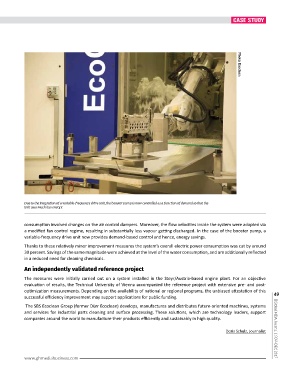
           Due to the integration of a variable-frequency drive unit, the booster pump is now controlled as a function of demand so that the
           unit uses much less energy.


           consumption involved changes on the air control dampers. Moreover, the flow velocities inside the system were adapted via
           a modified fan control regime, resulting in substantially less vapour getting discharged. In the case of the booster pump, a
           variable-frequency drive unit now provides demand-based control and hence, energy savings.
           Thanks to these relatively minor improvement measures the system’s overall electric power consumption was cut by around
           30 percent. Savings of the same magnitude were achieved at the level of the water consumption, and are additionally reflected
           in a reduced need for cleaning chemicals.


           An independently validated reference project
           The  measures  were  initially  carried  out  on  a  system  installed  in  the  Steyr/Austria-based  engine  plant.  For  an  objective
           evaluation of results, the Technical University of Vienna accompanied the reference project with extensive pre- and post-
           optimization measurements. Depending on the availability of national or regional programs, the unbiased attestation of this
           successful efficiency improvement may support applications for public funding.                          49
            The SBS Ecoclean Group (former Dürr Ecoclean) develops, manufactures and distributes future-oriented machines, systems
           and services for industrial parts cleaning and surface processing. These solutions, which are technology leaders, support
           companies around the world to manufacture their products efficiently and sustainably in high quality.


                                                                                               Doris Schulz, Journalist   | Global MDA Journal | NOV-DEC 2017


           www.ghmediabusiness.com

