


Page 272 - Hamlet: The Cambridge Dover Wilson Shakespeare
P. 272
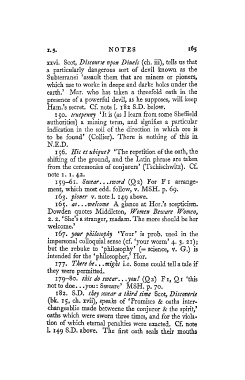
1.5.                NOTES                     165
                xxvi. Scot, Discourse vpon Diuels (ch. iii), tells us that
                a particularly dangerous sort of devil known as the
                Subterranei 'assault them that are miners or pioners,
                which use to worke in deepe and darke holes under the
                earth.' Mar. who has taken a threefold oath in the
                presence of a powerful devil, as he supposes, will keep
                Ham.'s secret. Cf. note 1. 182 S.D. below.
                   150. truepenny 'It is (as I learn from some Sheffield
                authorities) a mining term, and signifies a particular
                indication in the soil of the direction in which ore is
                to be found' (Collier). There is nothing of this in
                N.E.D.
                   156. Hie et ubique? 'The repetition of the oath, the
                shifting of the ground, and the Latin phrase are taken
                from the ceremonies of conjurers' (Tschischwitz). Cf.
                note 1. 1. 42.
                   159-61. Swear., .sword (Q2) For F i arrange-
                ment, which most edd. follow, v. MSH. p. 69.
                   163. pi oner v. note 1. 149 above.
                   165. as.. .welcome A glance at Hor.'s scepticism.
                Dowden quotes Middleton, Women Beware Women,
                 2. 2. 'She's a stranger, madam. The more should be her
                welcome.'
                   167. your philosophy 'Your' is prob. used in the
                impersonal colloquial sense (cf. 'your worm' 4. 3. 21);
                but the rebuke to 'philosophy' (= science, v. G.) is
                intended for the 'philosopher,' Hor.
                   177. There be... might i.e. Some could tell a tale if
                they were permitted.
                   179-80. this do swear.. .you! (Q2) Fr, Qi 'this
                not to doe.. .you: Sweare' MSH. p. 70.
                   182. S.D. they swear a third time Scot, Discoverie
                (bk. 15, ch. xvii), speaks of 'Promises & oaths inter-
                changeablie made betweene the conjuror & the spirit,'
                oaths which were sworn three times, and for the viola-
                tion of which eternal penalties were exacted. Cf. note
                1. 149 S.D. above. The first oath seals their mouths

