


Page 11 - Thinking Critically
P. 11
12   T��n��n�� C��t���������


                             In some study disciplines, critical thinking is used particularly in the
                             formal evaluation or construction of an ‘argument’. Knowing what
                             constitutes an argument will help you identify what is happening
                             when someone makes an inadequate argument.

                             2.2 What is an ‘argument’?  What is an ‘argument’?What is an ‘argument’?

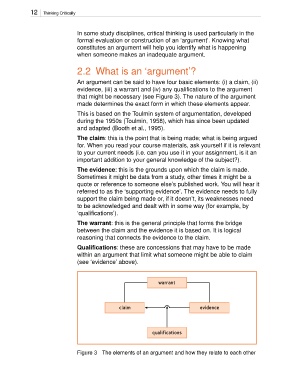
                             An argument can be said to have four basic elements: (i) a claim, (ii)
                             evidence, (iii) a warrant and (iv) any qualifications to the argument
                             that might be necessary (see Figure 3). The nature of the argument
                             made determines the exact form in which these elements appear.
                             This is based on the Toulmin system of argumentation, developed
                             during the 190s (Toulmin, 198), which has since been updated
                             and adapted (Booth et al., 199).

                             The claim: this is the point that is being made; what is being argued
                             for. When you read your course materials, ask yourself if it is relevant
                             to your current needs (i.e. can you use it in your assignment, is it an
                             important addition to your general knowledge of the subject?).
                             The evidence: this is the grounds upon which the claim is made.
                             Sometimes it might be data from a study, other times it might be a
                             quote or reference to someone else’s published work. You will hear it
                             referred to as the ‘supporting evidence’. The evidence needs to fully
                             support the claim being made or, if it doesn’t, its weaknesses need
                             to be acknowledged and dealt with in some way (for example, by
                             ‘qualifications’).
                             The warrant: this is the general principle that forms the bridge
                             between the claim and the evidence it is based on. It is logical
                             reasoning that connects the evidence to the claim.
                             Qualifications: these are concessions that may have to be made
                             within an argument that limit what someone might be able to claim
                             (see ‘evidence’ above).


                                                           warrant


                                             claim                        evidence


                                                         qualifications


                             Figure 3  The elements of an argument and how they relate to each other


                                                                       ����������������������
                                                                       ������  ����������������  ���  �
                                                                              ���
                                                                       ������  ���������   ����  ��������
                                                                       ���������           ����
                                                                       ������              ����
                                                                       ������  ��������    ����  ��
                                                                       �������             �������
                                                                       �����               �����

