


Page 108 - BBC Wildlife Volume 36 #02
P. 108
INSIDE THE IMAGE


                           POLAR BEARS SVALBARD


                                       The remote, rugged
                                       archipelago of Svalbard is
                                       home to a variety of Arctic
                             wildlife, but its most famous denizen
                             has to be the polar bear. In winter the
                             large ice floes surrounding the islands
                             provide vital hunting grounds for the
                             species’ key food source: seals. If the
                             ice doesn't form, the animals become
                             marooned on the islands where they
                             risk starving to death.
                             CLOSE FOR COMFORT
                             While our ship was anchored off
                             Duvefjorden, we suddenly spotted a
                             female with a two-year-old cub. The
                             pair became aware of our presence and
                             started to walk towards us, driven by
                             hunger and, perhaps, curiosity. As they
                             approached, the bears were distracted
                             by a nearby leak from the ship’s
                             kitchen, which had stained a patch of
                             snow. They paused to lick it, pressing
                             their legs together and adopting                         1
                             synchronous, almost identical positions.
                               Initially, the bears were a significant                                                             3
                             distance away, giving me time to
                             mount a 200–400mm lens and
                             photograph them as they wandered
                             towards us. The animals eventually
                             came so close that even the minimum
                             focal length of 200mm was too tight to
                             include any of their surroundings.
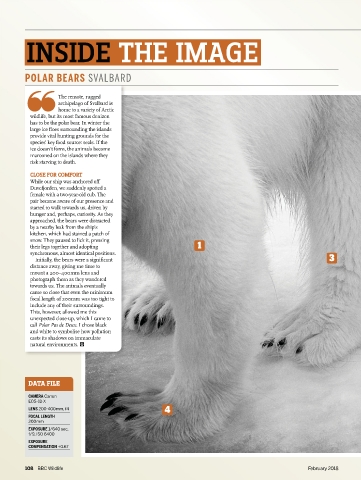
                             This, however, allowed me this
                             unexpected close-up, which I came to
                             call Polar Pas de Deux. I chose black
                             and white to symbolise how pollution
                             casts its shadows on immaculate
                             natural environments.


                             DATA FILE

                             CAMERA Canon
                             EOS-1D X
                                                                           4
                             LENS 200-400mm, f4
                             FOCAL LENGTH
                             200mm
                             EXPOSURE 1/640 sec,
                             f/9, ISO 6400
                             EXPOSURE
                             COMPENSATION +0.67


                           108 BBC Wildlife                                                                                February 2018

