


Page 109 - BBC Wildlife Volume 36 #02
P. 109
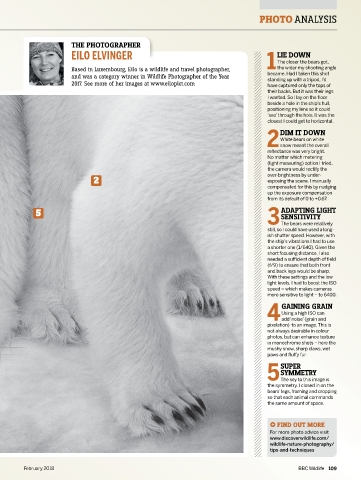
PHOTO ANALYSIS
THE PHOTOGRAPHER
EILO ELVINGER LIE DOWN
The closer the bears got,
Based in Luxembourg, Eilo is a wildlife and travel photographer, 1 the wider my shooting angle
became. Had I taken this shot
and was a category winner in Wildlife Photographer of the Year
standing up with a tripod, I’d
2017. See more of her images at www.eilopict.com have captured only the tops of
their backs. But it was their legs
I wanted. So I lay on the floor
beside a hole in the ship’s hull,
positioning my lens so it could
‘see’ through the hole. It was the
closest I could get to horizontal.
DIM IT DOWN
White bears on white
2 snow meant the overall
reflectance was very bright.
No matter which metering
(light measuring) option I tried,
the camera would rectify the
over-brightness by under-
2 exposing the scene. I manually
compensated for this by nudging
up the exposure compensation
from its default of 0 to +0.67.
5 ADAPTING LIGHT
SENSITIVITY
3 The bears were relatively
still, so I could have used a long-
ish shutter speed. However, with
the ship’s vibrations I had to use
a shorter one (1/640). Given the
short focusing distance, I also
needed a sufficient depth of field
(f/9) to ensure that both front
and back legs would be sharp.
With these settings and the low
light levels, I had to boost the ISO
speed – which makes cameras
more sensitive to light – to 6400.
GAINING GRAIN
Using a high ISO can
4 add ‘noise’ (grain and
pixelation) to an image. This is
not always desirable in colour
photos, but can enhance texture
in monochrome shots – here the
mushy snow, sharp claws, wet
paws and fluffy fur.
SUPER
SYMMETRY
5 The key to this image is
the symmetry. I closed in on the
bears’ legs, framing and cropping
so that each animal commands
the same amount of space.
+ FIND OUT MORE
For more photo advice visit
www.discoverwildlife.com/
wildlife-nature-photography/
tips-and-techniques
BBC Wildlife 109

