


Page 18 - BBC Wildlife Volume 36 #02
P. 18
WILD
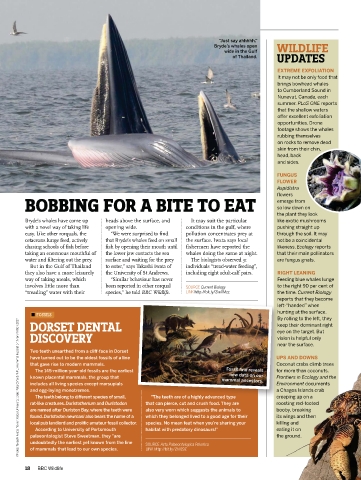
“Just say ahhhhh.”
Bryde’s whales open WILDLIFE
wide in the Gulf
UPDATES
of Thailand.
EXTREME EXFOLIATION
It may not be only food that
brings bowhead whales
to Cumberland Sound in
Nunavut, Canada, each
E
summer. PLoS ONE reports
that the shallow waters
offer excellent exfoliation
opportunities. Drone
footage shows the whales
rubbing themselves
on rocks to remove dead
skin from their chin,
head, back
and sides.
FUNGUS
FLOWER
BIRDS Aspidistra
flowers
BOBBING FOR A BITE TO EAT emerge from
so low down on
the plant they look
Bryde’s whales have come up heads above the surface, and It may suit the particular like exotic mushrooms
with a novel way of taking life opening wide. conditions in the gulf, where pushing straight up
easy. Like other rorquals, the “We were surprised to find pollution concentrates prey at through the soil. It may
d
h
l
f
f
l
h
d
l
f
l
cetaceans lunge feed, actively that Bryde’s whales feed on small l the surface. Iwata says local l not be a coincidental
h
l
d
chasing schools of fish before fish by opening their mouth until fishermen have reported the likeness. Ecology reports
y
taking an enormous mouthful of the lower jaw contacts the sea whales doing the same at night. that their main pollinators
water and filtering out the prey. surface and waiting for the prey The biologists observed 31 are fungus gnats.
But in the Gulf of Thailand to enter,” says Takashi Iwata of individuals “tread-water feeding”,
they also have a more leisurely the University of St Andrews. including eight adult-calf pairs. RIGHT LEANING
way of taking meals, which “Similar behaviour has never Feeding blue whales lunge
involves little more than been reported in other rorqual SOURCE Current Biology to the right 90 per cent of
“treading” water with their species,” he told BBC Wildlife. LINK http://bit.ly/2iwVMzz the time. Current Biology
re
reports that they become
eft-“handed” when
le
h unting at the surface.
Q FOSSILS
By rolling to the left, they
B
Whales: T akashi Iwata; flower: Kobe University; crab: Pete Oxford/NPL; mammal illustration: Mark Witton 2017
DORSET DENTAL ke eep their dominant right
ey
ye on the target. But
DISCOVERY v ision is helpful only
n ear the surface.
Two teeth unearthed from a cliff-face in Dorset
UPS AND DOWNS
have turned out to be the oldest fossils of a line U
that gave rise to modern mammals. Co oconut crabs climb trees
The 145-million-year-old fossils are the earliest Fossil find reveals fo or more than coconuts.
new data on our
known placental mammals, the group that Fr rontiers in Ecology and the
mammal ancestors.
includes all living species except marsupials En nvironment documents
and egg-laying monotremes. a Chagos Islands crab
cr
The teeth belong to different species of small, “The teeth are of a highly advanced type creeping up on a
“The teeth are of a highly advanced type
rat-like creatures. Durlstotherium and Durlstodon that can pierce, cut and crush food. They are roosting red-footed
are named after Durlston Bay, where the teeth were also very worn which suggests the animals to booby, breaking
found. Durlstodon newmani also bears the name of a which they belonged lived to a good age for their its wings and then
local pub landlord and prolific amateur fossil collector. species. No mean feat when you’re sharing your killing and
According to University of Portsmouth habitat with predatory dinosaurs!” eating it on
palaeontologist Steve Sweetman, they “are the ground.
undoubtedly the earliest yet known from the line
SOURCE Acta Palaeontologica Polonica
of mammals that lead to our own species. LINK http://bit.ly/2hlI19Z
18 BBC Wildlife

